Cactus Blog Archives

California Native Succulents


It’s the Dudleyas!!!

dudleya_pulverulenta4

Dudleya pulverulenta

dudleya_hassei4

Dudleya hassei

dudleya_densiflora

Dudleya densiflora

dudleya_caespitosa3

Dudleya caespitosa

Here’s where in the blog post that is here that I say something about the plants. Should I tell you something unique and interesting about each species? Or each individual plant I photographed? Or maybe about the Genus?

No!

I will tell you about the family. The Crassula Family (Crassulaceae)! You can find Crassulaceaes from all around the world – every single continent that has Crassulaceaes are fun places to garden. We have Dudleyas and Sedums in California. In Mexico they have a lovely crop of Echeverias. In Europe the Sempervivums rule the Alps. In South Africa the Crassulas are quite varied. Aeoniums live on the Canary Islands. There are some spectacular Kalanchoes on Madagascar. The highly poisonous Tylecodons are from Namaqualand.

And the Dudleyas? They are from California of course, including Baja and other parts of Northern Mexico. And their range extends into Arizona and Nevada and even north to Oregon, but not too far north into Oregon.

Did you know that there used to be a lot of confusion between Echeverias and Dudleyas? It’s true! But now they have it all sorted out.

Read More...
Read More...

Coming Soon


Rhytidocaulon macrolobum ssp macrolobum

Rhytidocaulon macrolobum ssp. macrolobum flower buds are covering this plant. Very small. We have been growing this now for 3 years and the first crop of cuttings are looking good. So maybe they will be ready by spring? I can’t wait!

In the Stapeliad family. This used to be it’s own family, but then it got moved into the Milkweed Family (Asclepiaceae) but now it’s in the Dogbane Family (Apocynaceae) and the Milkweeds are a Subfamily (Asclepiadoideae) of the Dogbanes and the Stapeliads are a Tribe (Stapeliae) of the Milkweeds. That means that the Pachypodiums and the Hoyas are in the same Family? That can’t be right.

Anyway, the Rhytidocaulon has soft stems, rich dark green color with 1/2″ green striped blooms. Keep warm and dry.

Read More...
Read More...

Ripley's Believe it or Not Cactus


(A) 16-foot cactus landing on a man gets attention from “Ripley’s Believe It or Not!”

…the 16-foot saguaro fell onto him and pinned him to the ground….

…There were also 146 cactus spines stuck in him….

OK, let’s get to the part where Ripley’s adds this to a book.

Ripley’s annual book of weirdness, Dare to Look!, tell us Mason’s featured in the “body” section… along with “giraffe women”… but it’s not in the same section as the guy who clipped 161 clothespins to his face…

Interesting.

Read More...
Read More...

Irish Succulents


Advice for children in Ireland, from Ask Marie.

Q: My young son wants to grow some succulents and cacti in a conservatory. Can you recommend some?

A: Head over to see the collection in the National Botanic Gardens, Dublin. It is one of my favourite places to visit and the variety is amazing.

Aloe and agave are good choices, as are lithops. If you have small children, it might be better to start off with the lithops, maybe little succulents and some sedums, as the spiny agave might cause injury.

OK, so I can’t agree with the 2nd part of this advice. Sure go visit the Dublin Gardens, the photos are nice! But suggesting you start a child off with Agaves or Lithops is criminal. Sure, an Aloe will be useful after the child gets stabbed by the Agave, but what will help with the tears when the Lithops rots and dies from overwater?

Read More...
Read More...

California Native Agave


agave_shawii3

Agave shawii is a coastal California native, Southern Cal. and Baja, but still coastal so you know it will do well in Berkeley and nearby. While the rosettes will get 2 to 3 feet across, taller than wide, they will also form large clusters so the agave can take over an area easily 10 feet across if you let it. And with those gorgeous red spines on the new leaves glowing in the California sunshine why wouldn’t you let it? Once they’ve formed a large enough cluster it would be difficult to remove, so make sure you have it in a place you want it.

Full sun at the coast, it could do with afternoon shade further inland.

Should not bloom until 15 to 20 years old, and then the bloom stalk could be particularly impressive for such a smaller species – up to 40 feet tall? Harsh!


Read More...
Read More...

Questions?!?


Hi Peter,

We talked on the phone a few minutes ago regarding paling/brown color that’s appearing on my cactus. Based on the attached pictures do you have any advice?

image(1)

Thanks so much!
-Chris

Chris,
It’s hard for me tell for sure, but it looks like a little bit of discoloration at the very bottom of the cactus. What I can see looks like it might be a bit of rot. Looking at the pointed-top shape of the cactus, I’m guessing it is not getting enough light, and even though you are only watering every 3 weeks, with that amount of light it would want less water. But mostly it wants more sun.

First, regarding the discoloration – push gently against it to see if it is soft. If it is then it is the start of some rot. I recommend spraying with Hydrogen Peroxide, and a few days later following up with an organic fungicide like Neem (although not Rose Defense).

Make sure the soil is completely dry before watering. And bring the plant out into more sun – although not all at once. Every day bring it into about 1/2 hour more direct sunshine until it is getting at least 4 hours direct sun.

Peter

Read More...
Read More...

Delicious Cactus


A news story out of Texas without comment.

Georgetown Police Chief Wayne Nero said Stephanie Hoskins Brown drank the juice of a San Pedro cactus that was cooked so that it produced mescaline, a hallucinogenic drug that is illegal in Texas.

OK, I can’t not comment on this. But rather than comment on the specific Texas Police Officer and the specific Texas laws and the specific very conservative Texas legislature, I’d rather comment on the beautiful, stunning Big Bend NP in the SW corner of Texas. My comment is as follows, “It’s Great!”

Let me just add that you don’t cook an Echinopsis pachanoi to produce mescaline. You cook it to make it palatable. The mescaline was already there.

Read More...
Read More...

A Game of Guitar-Playing Cactuses


Hello Hero, a turn-based RPG for smartphones developed in Korea, is headed to the west. You control a team of five heroes across the planet of Armon, including quirky characters like a guitar-playing cactus and a spear-wielding shark.

Good to know. Here’s a video.

That’s not a very interesting looking cactus. I wouldn’t play that game.

Read More...
Read More...

Gold Butterflyweed


Nicole took home this adorable little caterpillar but not before I got a photo and edited it on my phone with cute editing software. And the plant underneath of course is aButterfly Milkweed.

IMG_20130909_064928

Asclepias “Silky Gold”

Native to South America
Semi-Evergreen Perennial

Sun: Sun to Partial Shade
Water: Moderate
Size: 3 to 4 ft tall

Brilliant gold-yellow blooms atop each stem in fall. Green leafy stems. Hardy to 15F. Can be grown as an annual; collected seeds can be planted in spring. Attracts Monarch butterflies.

Read More...
Read More...

It's a Prickly Pear Cactus Story from the 1930s!


This story comes to us from Kansas, homer to grasslands that are good for cows, not for cactus, according to the US Government.

Max Schick was a boy of 10 back in the mid ‘30s when the U.S. government paid people 50 cents an acre to rid their grass of prickly pear cactus.

You should click through to find out if he got spined. And don’t forget the arrowheads…

Read More...
Read More...

Butterfly Milkweed


image

It’s the beautiful Asclepias tuberosa.

Butterfly Milkweed
Native throughout the US, including California
Herbaceous Perennial

Sun: Prefers Full Sun, Handles Light Shade
Water: Moderate, drought-tolerant
Size: 2 feet tall

Dies back in winter and re-sprouts from its underground tuber each spring. The brilliant orange or red flower clusters appear in midsummer followed by attractive green pods.

Read More...
Read More...

Non-Native Salvias


The Salvias are blooming and the colors are quite vibrant. These are the non-california Sages, since the california sages are not currently blooming.

But get a load of these non-native sages.

salvia chamaedryoides

Salvia chamaedryoides
Blue Chichuahuan Sage
Native to Mexico
Evergreen perennial

Sun: Sun/Shade
Water: Low
Size: 2 ft. to 3 ft.

Low mounding sage with soft green leaves and year-round tall blue bloom spikes. Hardy to 20° F

salvia bezerkeley

Salvia “Berzerkeley”
Baby Sage
Hybrid
Evergreen perennial/shrub

Sun: Full to Part Sun
Water: Low
Size: 18″ to 24″

Cultivar originally found at Monterey Bay Nursery. Dense and compact with deep pink flowers. Will bloom through fall into winter. Best with good sun, except in hotter areas. Attracts hummingbirds and butterflies. Hardy to 20F.

salvia_patens_royal_blue

Salvia “Royal Blue”
Blue Gentian Sage
Native to Mexico
Evergreen perennial

Sun: Sun to Part Shade
Water: Moderate
Size: 1 to 2 ft.

Large dark green leaves topped with lots of royal blue flowers all summer long and into the fall. Needs some summer irrigation. Hardy to 10F.

Read More...
Read More...

Transplanting Cactus


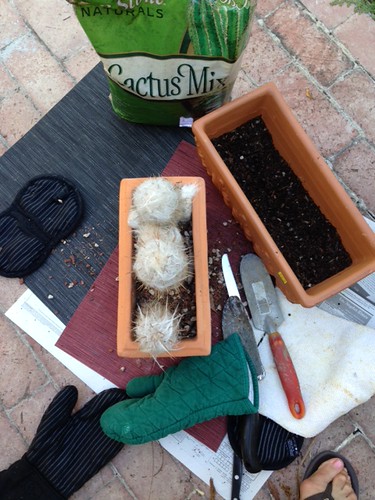
Peggy called and needed to transplant the cacti she had bought from us, but she now lives elsewhere so we talked her through the process and pictures ensued.

Hi
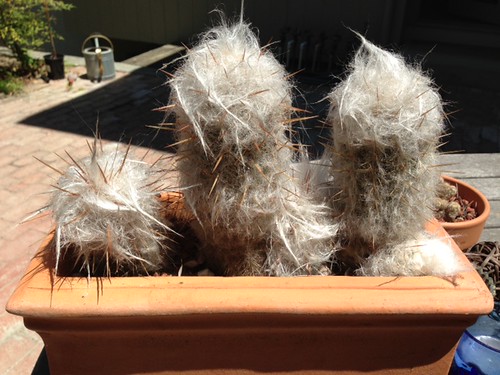
We purchased an Oreocereus trolli in 2009. We since moved to Los Angeles and cacti out grew its container and spawned three-four new growths. I called a month or so ago and spoke to someone about transplanting it. I was able to transfer it this morning, I promised to send photos.

Best
Peggy

Here’s what it looked like before the repotting. Nice!

1_transplant 2_transplant 3_transplant

And the final result…. After the break…. (more…)

Read More...
Read More...

Pitcher Plants


image

Sarracenia ‘Judith Hindle’ is very colorful and very frilly too. The new spring pitchers will come in more whitish-greenish, but those vibrant reds with sun will put on quite the show by this time of year.

It’s an American hybrid, with 3 species parentage: S. leucophylla x flava x purpurea.  Nice! These will get 20″ tall.

image

Sarracenia “Dixie Lace” has arching pitchers, splayed outwards, and unique flattened hoods. The golden color is also unusual.

The hybrid parents are S. leucophylla x alabamensis x psittacina, roughly speaking, though from other subspecies and cultivars of course.

Care: As with other Sarracenias, plant in 1/2 peat, 1/2 sand. While you can grow them indoors without a winter cold period, they will live for many more years if you let them go fully dormant for up to 3 months, below 40°F. They are quite cold tolerant if kept outdoors in a bog garden. Water with rainwater or distilled water for longest life, or you may have to flush the soils of salts periodically.

Read More...
Read More...

Variegated Corncob Succulent


euphorbia mammillaris variegata

Portrait of a Euphorbia mammillaris variegata coming into bloom with all the pretty colors.

It is from the Little Karoo region of South Africa. It will grow maybe a foot tall and will sprawl outwards with many new branches growing along the older branches. (more…)

Read More...
Read More...

Chincherinchee


Ornithogalum

Ornithogalum saundersiae is a succulent bulb in the Hyacinth family. The bloom stalks will get 5 feet tall and the white flowers have these unusual black centers. Usually it is a late-winter bloomer but we have one blooming…. Right Now!!!! Hardy to 10F.

Ornithogalum saundersiae

Another look at the flowers. You can see the bulb below if you look carefully.

ornithogalum_saundersiae

And here’s the bulb below, in a Portrait-style picture. Cute!

Read More...
Read More...

Carnivorous Plant Question


A complex and detailed question?

Carnivorous plant

carnivorous plant terrariums

Dead or dormant?

Thanks

Adam

Adam,

I would say there is still hope for the Sarracenia. The problem is there is too much water. These are bog plants, which generally means they prefer very moist soils, but not where the water line is above the soil like you would do for a pond plant. And in a terrarium where the water is not moving, the water needs to be able to go down.

I recommend carefully tipping the terrarium over to get all the water out, holding the plant in place as best you can. When you water, add enough to let the water sit at the bottom just high enough to get above the charcoal and into the soil, and then let the water go down below the soil/charcoal line before adding more water.

Hopefully there will be new growth within a couple weeks.

Peter

Read More...
Read More...

Rare Succulents, Whitesloanea Edition


Whitesloania crassa flower bud

Whitesloanea crassa is a rare and unusual succulent in the Stapeliad Family (Actually the Dogbane Family Apocynaceae or the Milkweeds Family Asclepiadaceae, depending on who you ask.)

And then that cute little flower bud opened up and we had a beautiful and vibrant and hairy flower.

Whitesloania crassa flower

They come from the hills of Somalia where they grow with just a little bit of sun and in very gritty soil with very little water. That’s exactly what I would have guessed! We tend to reduce the water in the winter down alm,ost to nothing, but not quite. In summer I keep it in a hot window and water with half as much as my other succulents, but once per week.

Join me after the break to see what a branching Whitesloanea looks like. (more…)

Read More...
Read More...

Cactus Helpline


Help! The rotten wind knocked my pot full of cacti off the sill and my beloved cacti are all messed up! My tall column cactus is in the worst shape. Although he is still whole, he seems to have internal damage, as in, he feels squishy in some areas. He also has a couple of external damage marks (see white streaking at top and discoloration near bottom). The other sprawling one came completely out of the pot, but otherwise seems Ok, and the other one stayed in the pot and seems Ok also. I am really sick about this. I have had them for years (since tall guy was just a few inches tall) and really hope they can be saved. P. S. Also can you please identify the types?

photo(11)

Thank you,
Louise

Louise,
The tall one is probably a Cereus. The white streaks are where there was bending stress. That should heal over. If the bottom of the cactus is soft and not just discolored then you need to cut the cactus off above the rot and try to root the new cutting.

Basically you need to cut above the rot, making sure there is no rot inside at the cut edge. Spray the cut with hydrogen peroxide and set aside to dry for 2 to 3 weeks.

If you see rot when you cut, keep cutting higher until there is no rot in the branch.

When the branches are fully healed over you can plant them in dry cactus soil and keep dry for a few more weeks. Water only every 3-4 weeks. Do not re-use any of the old soil as it is possibly infected.

The sprawling one, I’m not sure what it is but it looks like it can be repotted just fine.

In general it looks like you needed to repot these into larger pots at this time anyway.
Peter

Read More...
Read More...

See Inside the Cactus Jungle


Did you know that Google stopped by and photographed the inside of the nursery and you can see the result of that here on Google See Inside?

Nice!

Now it is true that this happened 3 years ago so the nursery looks very different now. In a good way! But still, you get a pretty good idea from the googles.

Now we have a question about a plant someone saw on our google page.

Hi cactus jungle!

I was being a creep and looking at the google maps street view of your store when I saw a plant I fell in love with immediately! It’s the one to the right of the bamboo in that picture, to the left of the white arrow. Looks like a little tree with bright green neon leaves. What is that thing and how can I get one I must have it!

streetview

Anyway, thanks for having such a great blog I love it!

– Mary

Mary,

That is a Manzanita (Arctostaphylos). We do have lots in stock. That one was potted into a terra cotta pot and trimmed up to look like a bonsai. I’m not sure exactly which species since the photos for Google’s See Inside were taken over 3 years ago.


Peter

Read More...
Read More...

More Prickly Pears and Beavertails


Some closer-ups of yesterday’s Opuntias. Plus a bonus flowering cholla, also theoretically an Opuntia, but not exactly.

image

Blue Beavertail

image

Used to be an Opuntia, now considered a Tacinga, though still in the Opuntiodeae tribe.

image

Close up of a different Beavertail Cactus!

image

Bonus cholla… Used to be an Opuntia, now a Cylindropuntia.

Any guesses as to the species of them all? I gave good hints.

Read More...
Read More...

Prickly Pears and Beavertails


That’s a lot of spiny cactus. Can you name them all?

prickly pear cactus and beavertail cactus

That’s a lot harder than column cacti below since there are hybrids and cultivars in the bunch here, whereas the column cacti were all species.

Still, you can zoom in pretty close to check it out in all its Hi-Def beauty and glory.

Read More...
Read More...

Column Cactus


Ever wonder what a column cactus would look like if you had a whole lot of them in one place at the same time? Here, take a look. That’s a lot of column cacti at the Cactus Jungle now.

Column Cactus

Who can name them all? And not you Keith, employees who could go look a the tags are not included.

If you’re not sure of them all then click the photo to embiggen. It will get really embiggened, so you can check the finer points of the aureoles and such.

Read More...
Read More...

How to Grow Cactus


Line the seedlings up in a tray. Give them lots of sun, maybe some late afternoon shade. Water occasionally.

Enjoy!

Pachycereus marginatus

Pachycereus marginatus, Organ Pipe Cactus

Cleistocactus hyalancanthus

Cleistocactus hyalacanthus

Oooohh, photogenic!

Read More...
Read More...
    
    
  Cactus and Succulents
  Bamboo
  Perennials
  Carnivorous Plants
  Airplants

April 2026
M T W T F S S
 12345
6789101112
13141516171819
20212223242526
27282930