Sometimes these questions we get are very difficult and the answers take a long time to write, and we have to ponder and fiddle and germinate and have a coffee break. This is not one of those times.
Hello,
Is it possible to ask you to look at this plant and see if you know what it is please. I thought Haworthia or agave or yucca, but searching these has not been successful so far.
Thanks for your time,
John
John,
You have a very nice Agave leopoldii. Congratulations.
Peter
Cactus, like people, can sunburn. But unlike people, the plant’s burn never goes away. It may seem odd that the heat-loving, desert-dwelling plants can be so sensitive, but that was just one of the tidbits of information offered Saturday during the weekly discussion at Green Things nursery’s winter horticulture series (AZ).
Well…. If it’s just a minor burn, the plant can heal over. Major burns can kill the plant, or cause permanent damage.
This Costa Rican native grows to anywhere from 3 to 6 ft. across, and is very popular in cultivation for its colorful marginated and variegated varieties. Here we see one in its native habitat – a sunny field. Let’s romp.
Haworthia retusa grows best in shade. The tops of the leaves can bleach out in full sun, which is not good for you or the plant. But with a little sun, there are hints of red, a touch of cinnamon, so to speak. Strange little gray flowers on extremely long stems, like all the haworthias. Why, you can see the flower stalk just starting to poke out.
The University of South Florida has a lovely Botanic Garden, and the good people at the Tampa Tribune think the best part about it is the succulent house.
Take a stroll through the Botanical Gardens at USF and you’ll likely fall in love… Unrequited plant love is one of the top five causes of gardener heartache.
Angel wing begonia
There are several cultivars of angel wing, which takes its name from the shape of its leaves.
Hoya carnosa
Tribune photo by PENNY CARNATHAN
One of (our) favorite plant genera is hoya, which includes about 300 species of tropical climbers, many of them epiphytic vines.
Sometimes I like to make up things about the articles I post. Like in this case, I’d like to imagine that the writer is actually a WWII bomber pilot from Connecticut who recently built a new greenhouse outside the kitchen backdoor, but it’s still too cold out there for the hoyas and begonias, so they’re languishing in the garage.
Kevin Nortz / The Herald
Crassula (left), Echeveria ‘Metallica’ and Sedum ‘Angelina’ (right) are part of a 3-foot-by-5-foot living wall that will be featured in the “Sky’s the Limit” garden at the Northwest Flower & Garden Show.
They’re showing off green roofs.
Green roofing squares planted with sedums, solar panels and living walls, painstakingly built and crafted… with sedums and succulents forced into summer glory by T&L Nursery in Redmond.
We’re going this year, so look for us there. Hah! Just kidding. The nursery is buzzing with pre-spring activity so we’re staying put.
This name is a contested name. Some would call it H. retusa ssp asperula. Some would say it is an unnamed or unresolved H. retusa. But I like the name asperula so I am not willing to give it up. That’s the thing with haworthias. They interbreed and hybridize readily. They all look alike. The subspecies of one species may look more like another species. Oy, the confusion reigns. Therefore, I photograph what I have for posterity.
Today’s plant has no common name. Will you help me choose one?
So this season of Survivor is in the desert highlands of Brazil, so they were bound to run into some cactus. Here’s one description of the upcoming season from Metro, which appears to be some kind of website, so you know they have good info.
“Survivor Tocantins” takes place in brutal high desert conditions…
Contestants have access to Cactus Juice (a combination of sunscreen and bug repellent) and essential medication (such as malaria pills), but no other personal items.
Wait, this so-called cactus juice is not the juice they personally squeeze out of a cactus, it’s a sunscreen product for sale? Why didn’t anyone tell me this? So let’s do the google and see what we come up with.
It’s true! Well this blog post has taken a turn. But back to Survivor. They’re bound to run into some cactus. So if you watch the show, let me know what they run into.
Parasitic wasps lay eggs in caterpillars using toxins to paralyze their hosts. The wasp young then eat their way out. A study in Science magazine confirms the genetics of wasp toxins rely heavily of the DNA of viruses that infected the insects millions of years ago.
In this lovely grouping of epiphytic plants, we see a cactus which is clearly a Hylocereus (probably H. costaricensis), a blooming Tillandsia (Oy they’re so bright – my eyes!), and a very happy orchid, species unknown.
I think we could all learn a lesson from these plants about living together and sharing. Here we have 3 very different species sharing a branch on a tree, slowly killing it off, together. Teamwork.
They get questions in Jacksonville, Florida about why a Crassula ovata is blooming. That’s strange. If it’s blooming, then stop asking questions already. Post the photo on Facebook, blog it, send a cutting to your grandchildren, have a nice plate of brownie sundae and be happy.
Q: I’ve had my jade plant for quite a few years, and it’s blooming now. Did you know they could bloom?
A: Jade plants are very popular succulent plants. They grow well here, if they are protected from the fall rains and cold. As succulents, they prefer to be allowed to dry out between waterings. They bloom regularly in California, producing their whitish starlike blooms.
They are triggered to bloom by long nights and a sharp contrast between day and night temperatures. We don’t see much of that until we get into winter here. They are not reliably hardy during our cold weather; 30 degrees is considered to be the cutoff point for survival, so I hope your plant has been coming inside during these northern blasts.
Good to know. But that really was a strange question to take the time and effort to send in to your local newspaper.
More from Obamiconme. I had trouble deciding on the message – DOG was a good one, BENJAMIN would have been boring, WHIPPET was obvious, but in the end I did what I could. Maybe a bit self-serving, but I’m worth it.
Sometimes I’m more diplomatic than other times. This is not one of those times.
Hi there,
My name’s Diane and I’m e-mailing you from Toronto.
A friend of mine gave me this cute little plant for my birthday two days ago. I’ve absolutely no clue what it is. I tried doing a Google search on my own, but no luck.
I’ve attached a few close-up pictures of the leaves. I asked Mr Subjunctive – he thinks it might be a kalanchoe of some sort, but he wasn’t sure.
What do you think? Do you think it’s a succulent of some sort? If you’ve got any clue, I’d appreciate it … or if you don’t know, but know someone who might, please let me know.
Thanks so much!
Diane,
Your plant is a Kalanchoe blossfeldiana.
I thought you might also want to know that your camera is very good at getting the closeups. In fact, it’s so good, that one can see all the little aphids infesting the plant. We recommend spraying with neem oil. You may also need to drench the soil.
We’re not sure what cactus this is that we found in the rain forests of Costa Rica, more specifically in Manuel Antonio NP, but it sure is impressive.
It is broad and flat like an epiphyllum, but long and pendulous like a selenicereus. Definitely not hylocereus. Maybe rhipsalis – they can be flat and long and pendulous, but they’re not usually that broad. If only we had gotten close enough to see any evidence of flowering. Damn jungle.
I occasionally reprint articles from Austin, especially when it concerns a certain art car filled with cactus that the legal system has deemed a public nuisance. No cactus news today, but yesterday they quoted my sister about a bicycle thief. Woohoo!
In February 2008, Clayton had caught the attention of Abigail Mahnke, host of the KOOP radio show “Inner Views.” The weekly program focuses on “everyday people with extraordinary stories.” Clayton seemed to fit the bill.
These lovely little plants top out at about 6″, 8 if you’re lucky. Very slow growing, but when they do choose to send out pups, they can send out 6 at a time! That’s good news for you. And for me too – slow to spread, but productive when it does. Do you know what I mean when I use the word “productive”? I mean that I’m propagating this plant and it’s giving me lots of babies to brutally pull off the mother plant and reroot in a new pot and put out for sale. And the pups all have lots of roots already! Woohoo! Productivity-City!
Now all I have to do is wait 2 years for the babies to get big enough and off they go.
Oh my god, it’s a dioscorea! I think it may be the very same Dioscorea discolor that we carry at the nursery! But then, there are 24 species of dioscorea found in Costa Rica, and it is grown around the world for its edible yam-like tubers. Did I say yam-like? I meant yams. Anyway, D. discolor is a succulent caudiciform, so what are ya’ gonna do?
How long do cactuses live? They always look like they’ve been there forever.
— Wayne, San Diego
Yep. They just sorta sit there, it seems. Most only grow a few inches a year. But since they don’t have growth rings like trees, and nobody’s hung around one cactus year after year to see how it goes, most estimates are educated guesses, pretty much. Short life span is maybe 25 years. But consider the saguaro. That’s the typical cartoon cactus with the robot arms and sometimes a Mexican peasant leaning against it. Those puppies apparently have convinced botanists they can live from 150 to 300 years. Maybe somebody found Cortez’s initials carved in one. Montezuma. Somebody like that. Anyway, all bets are off if the cactus is in a plastic pot on your desk. That probably has a life expectancy of six months, tops. Not because it dies, but because you get sick of it and throw it out.
And if you click the link, check out the question just before this one in the article.
The theme of (last) weekend’s Garden Show at Two Rivers Convention Center (wa)s “The Backyard Garden.”
Did I forget to mention this in advance? Oops.
If you need… advice on cactus, succulents, backflow prevention devices, (and) how to grow and use lavender… you can get all of these questions and more answered at the Garden Show. These are just a few of the exhibitors who will fill Two Rivers Convention Center in downtown Grand Junction.
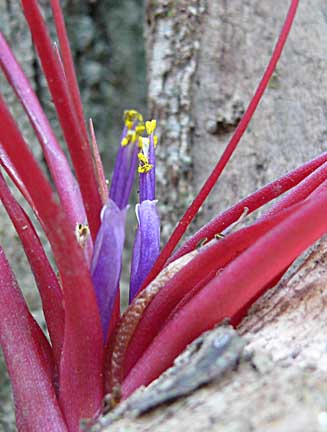
Tillandsia blooms. These look remarkably like the Tillandsia ionantha blooms we get at thre nursery. And T. ionantha is from the central american rain forest. So maybe, just maybe, we have identified a tillandsia species found on our recent trip to Costa Rica.
On the other hand, the rosette is probably too big to be T. ionantha. But it sure is pretty.
Do you kinow how many species of tillandsias there are? Why, there are 400. And if you include all the epiphytic bromeliads, then I believe you’d have at least some more than that, even.
Hah! I was just kidding. Actually, it’s a new National Geographic photo of a long lost mini primate.
It may look like a gremlin, but this tiny animal is actually a pygmy tarsier, recently rediscovered in the forests of Indonesia.
The 2-ounce (57-gram) carnivorous primate had not been seen alive since the 1920s….
“There have been dozens of expeditions looking for them—all unsuccessful. I needed to go and try to see for myself if they were really there or if they were really extinct,” added Gursky-Doyen, whose research was funded in part by the National Geographic Society’s Conservation Trust.
I like pygmy tarsiers. I think we could raise them at the nursery, in our new Indonesia section. What? We don’t have an Indonesia section? Well, we’ll just have to get one for the pygmy tarsiers.
Mealy bugs can infest both indoor and outdoor plants, though I have the most difficulty with them in winter. The range of houseplants they attack range from African violets and orchids to cacti and succulents. They can be particularly difficult to eradicate because they congregate in hard-to-reach nooks and crannies.
Common control methods call for a Q-tip and rubbing alcohol, painstakingly swabbing each one.
That’ll keep you busy all winter long. You’ll forget the storms outside while sipping a little of your own alcohol too. I prefer limoncello. For me, not the plants.