These hybrids are usually cultivated for the flower colors and huge sepals and year-round blooming, but this one has amazing wavy edged leaves, and is more vertical, less sprawling, than most of the milii’s. And what about those orange tinged spines? A very beautiful plant indeed.
Everyone loves a good carrion flower. These are kinda small, about an inch across, and so are not as violently smelly as some others. But they do have so many pretty colors and shapes, and little hairy parts too. Precious indeed. Click the image to get a closeup of the lovely flower.
Well, it’s true. The Clusia bud converted over this morning to a bloom.
Clusia orthoneura
I think it’s clear why they call this the porcelain flower, but if not, here’s a link to some porcelain figurines. Now is it clear? No? Well, how about this? What!?! Those porcelain flowers aren’t enough to convince you!?! I don’t know what more I can do to convince you of the propriety of the name “Porcelain Flower” for the Clusia. Maybe this will do it. Aha! Now you see what I’m talking about. And yet… Is there a picture of a porcelain cactus or succulent, just to be sure? There is! And it’s a triplet!
I’m feeling a bit silly right now. Sorry about that.
Come follow me after the break for a close up of this wacky and entertaining porcelain-like flower. Read More…
The stupid Clusia orthoneura bud won’t open. It’s been in bud for months. I keep telling myself “any day now” and nothing. It’s gotten humongous, but maybe tomorrow…
This is not a California native asclepias. There do seem to be a lot of cultivars of this species, although they all seem to look the same to me, so I think a bunch of people have just decided to attach a name to a productive individual and claim it as a separate cultivar. Can you detect my scepticism?
I wonder if this barrel is from Tiburon, right across the Bay? I suppose not, since it wouldn’t make sense to have a native barrel cactus from Tiburon – not really desert-y enough for a barrel. Must be a different Tiburon.
I wonder if there’s a Tiburon in Mexico? Tiburon Island seems to be a desert ecological wonderland, so I suppose that’s how it got it’s name.
Do you like small plants, because this one is small – Sedum nanifolium – the name means small leafed. This is the tiniest sedum I know of, but then there are hundreds of stonecrops, so I could be missing another one.
We still have a few of the Echinocereus/Echinopsis hybrids producing late blooms.
We call this one Echinocereus grandiflora “Caribbean Peach”
Dazzling colors are the hallmark of these giant flowers. Oh, to be a bee. The bees are also going crazy for the late Echinopsis pachanoi blooms. So much work to do before winter. And the bees are busy too.
Continuing in our series of baby plant photos, we have Southern California’s own succulent coreopsis with a profusion of yellow daisy flowers when they get larger than this, that is. And they’re in the Sunflower family, so you know they’re going to be pretty.
Winter-growing, so get them in the ground in the next couple months for maximum pleasure.
These are one of our more popular agaves through the years. We try to keep some small ones in stock, but we usually grow them from offsets, and they get bigger than this before we take them from their parent, so we don’t often have small A. parryi’s at all. Until now. We’ve started growing agaves from seed. So now we can have them in every size.
Myrtillocactus geometrizans – We’ve sold out of our large plants, so we grew some babies. Eventually they’ll be large too. Edible fruit – actually quite delicious! – called Whortleberry, taste a lot like blueberries – but better!
Ferocactus pottsi from the Chihuahuan desert is a very reliable bloomer. Not as brightly colored as some other fero’s, still, it is nicely striped. And as you can see, the buds are pretty too.
There don’t seem to be any common names associated with this, so I’m calling it the Leopard Barrel.
I wonder who this pottsi person was? Shall we look it up? It was originally named Echinocactus pottsii in 1850, and renamed F. pottsi in 1961. So that means the pottsi name is old, very old. There’s also an Opuntia and a Mammillaria named pottsii, also named by the same person who named this one, Salm Dyck.
Cylindropuntia whipplei – The crew have taken to calling this one “Cowboy Cactus” because it looks like it belongs in a classic Western. However, these are going to get only 2 to 3 ft. tall. And yes, for the first time, I am using a Cylindropuntia designation, instead of Opuntia. I’ve fallen into the trap of renaming all the chollas, although I’m feeling wary of the Austrocylindropuntia name. I don’t like this idea of dividing the genus based on North vs. South America.
I should also say we’re not really sure that this is C. whipplei – it’s out best guess. I actually thought it was A. shaferi, but we have some other chollas that are definitely A. shaferi, and they don’t look like this. So I got voted down. This is our best guess at this point. We’ll know better when they bloom.
I love featuring this cactus. Baby photos of the “Old Man” cactus are doubly cute – baby old men! Who can resist!
The chubby little thing will eventually grow to be a 2ft. tall clump of basally branched stems. I thought it grew taller, but that’s the O. celsianus I was thinking of. I better check the labels on the 5ft. tall plants at the nursery. We wouldn’t want to mislabel anything.
We let our cactus grow to 4″ size (nominal) before we’ll offer them for sale to the public at the nursery. Here we have the perfect specimen of a 4″ cactus.
Cleistocactus strausii
We grow these in sufficient quantities so that each year we can sell some small plants, and then grow the rest on to larger sizes, and the next year we sell a few more larger ones, and then grow the rest on to larger sizes, etc. We tend to grow them until they’re about 4ft. tall with many branches – that’s about the maximum size we would sell. Then we stop the growing. How do we do that? We sell them off post-haste so that you can finish growing them to 10ft. on your own time. These do incredibly well in Berkeley. They bloom heartily.
Here’s a photo of a mature specimen at the Berkeley Botanic Garden.
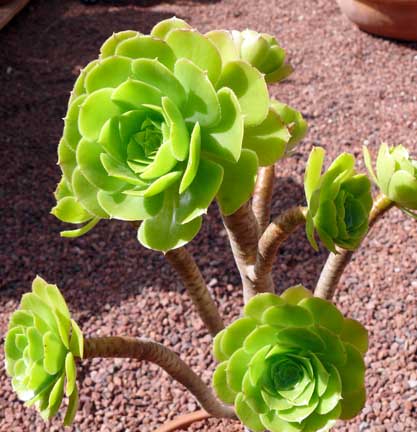
This one when it was little we thought was Aeonium tabuliforme, a very large dinner-plate sized flat semi-stemless rosette. And then it grew up and no longer looked like that. It’s still very flat, though. I wonder what it could be?
Aeonium pseudotabuliforme – yes, that’s right – that’s the name. At least it means we weren’t so far off in the first place.
Today we feature 2 smaller rosette aeoniums, that grow about 3ft. tall and are very branchy.
Aeonium holochrysum
Aeonium balsamiferum
Now we started with a crop of the holochrysums, and then when those were big, we bought another seedling tray of the same thing. When they were big enough, we potted some and sold the 2nd tray as holochrysums also. But when the rest grew bigger we realized they’re not the same plant. I’ve decided the 2nd plant is balsamiferum. It’s also possible they’re the same species, but different cultivars or subspecies.
But they look different enough to me that I can’t in good conscience call them the same plant.
Also, these are summer photos, when the rosettes are at their smallest. In the winter they’re a lot more full. But interestingly, these 2 shrink up more than a lot of our other aeonium species.
Yesterday we looked into some varied subspecies and cultivars of the A. arboreum. Today we look at a very confusing distinction between 2 very similar plants.
Aeonium canariense (or canariensis)
Aeonium subplanum
Some say these are the same plant, synonyms even. Others claim one is a subspecies of the other. I don’t know. What I do know is they are both large, low growing, green aeoniums, with pink-tipped leaf margins in full sun. However the plant we are calling canariense is taller, while the subplanum is broader (the photos make them look the same size, but the subplanum is actually twice as big across). Also the canariense leaves are fuzzier while the subplanum leaves are glossier. And the pink tinges on the 2 are slightly different colors.
It’s very confusing, all the different types of aeoniums. For instance, the popular “Schwartzkopf” is a cultivar off a subspecies off a species. So it could be properly called Aeonium arboreum ssp. atropurpureum c.v. “Schwartzkopf”. And then we have our own cultivar off that! very subtle differences.
Here’s our current list starting with A. arboreum.
These blueish cacti have blue-berry like fruit. And I can tell you here and now, they are delicious. If you are ever trapped in a desert-like environment, in Mexico, and you must find some food, I would try these. Now while it is true that tunas, i.e. prickly pear fruit, are even more delicious, unfortunately they are covered in spines, whereas these are not.
The name Whortleberry is also common to a type of berry-bearing heath from Europe, as well as a particular type of American blueberry. So much to learn.
Calibanus hookeri, a caudiciform member of the Agave family (Agavaceae) which we already said was maybe actually in the Lily family, but let’s not get that started all over again.
Here are the blooms. This is a male plant, as we can tell by the blooms. For some reason all our plants that we see bloom are male, and so that explains why we do not get seed.
As you can clearly see with this super slo-mo closeup, there are stamens there, composed of the little pollen-covered anthers on top of the slender filaments, but no pistils, i.e. the often quite graphic stigma in the center on top of the ovules.
These Neoregelias are a stunning group of small bromeliads. Hardy and luscious, great for terrariums. And what do you do if you forgot to water it and it starts to dry up? Well, let me tell you it is as easy as soaking it for 8 hours and watch those thick leaves come back to life. The centers of the plant are a favorite place to store a bit of extra water for your geckos, if you’re going on vacation. What, you don’t have geckos? Oh.
Nevermind.
So this one is Neoregelia puntissima v. rubra. Rubra, indeed.
From yet another vining caudiciform, this time in the Afrfican Violet family.
Sinningia tubiflora
These are pretty easy to take care of, grow caudexes readily from stem cuttings (very rare in the caudiciform world), will root in water (very rare in the succulent world), and drop and grow new leaves with less or more water – a beginner’s caudiciform!
Spectacular white tubular flowers with flared petals.
I’ve avoided using any of the many fine recent quotes from Gov. Sanford of SC, and Gov. Palin of AK, until today.
“I think on a national level your department of law there in the White House would look at some of the things that we’ve been charged with and automatically throw them out,” (Palin) said.