
Another shot of the large Aloe ferox coming into bloom. Any day now those buds should start opening, and the hummingbirds will go wild. There’s a lot of nectar in those buds.

and Ross Valley Nursery
Another shot of the large Aloe ferox coming into bloom. Any day now those buds should start opening, and the hummingbirds will go wild. There’s a lot of nectar in those buds.

Aeonium “Kiwi” is an A. haworthii hybrid, although people think it looks a lot like “Sunburst” which is an A. decorum hybrid.
It’s Aeonium season the past month, as the temps have dropped a bit and the rains have started too much, these winter-growing succulents are really taking off. It’s time to move the 4″ to gallons and the gallons to 10″ clay. So much to do around here to get ready for winter.

Oh, but those colors are natural, and real. You can make it go a bit of a muddy green with shade, but it doesn’t take a lot of sun to turn this brownish burgundy reddish color.
Echeveria “Fireball” indeed. And the blooms when open on the end of that curling bloom stalk will be a bright and vibrant red color, too.
The fruit is yet to come, if this flower was pollinated by bats, that is.

Cereus peruvianus
I see the giant Aloe ferox is in bloom, tons of buds about to open and all.

Overview after the break…. Read More…

Don’t be digging these up, please, if you happen to find yourself in Brazil, as they are endangered. And listed in CITES so you’d be breaking all kinds of laws too. Discocactus placentiformis is a flattened globose cactus that is my favorite new cactus we’ve had in a while. I think I will take this one home.

It’s Hap’s latest creation, a small metal succulent wall panel.
I thought you should know the Proteas have been blooming. This is a very photogenic hybrid, with the vibrant colors and the giant cone flower nestled within the crown of luscious green leaves. I hope I’ve described it well.

Protea “Pink Ice”
This one is my favorite that we’ve made. It has a small lichen covered branch and a Tillandsia ionantha with a dash of sand on the bottom. So cute, it’s only 2″ tall.

I don’t know the species of this, and I can’t find any Puyas with such a yellow flower. Maybe it’s a different terrestrial bromeliad entirely, although the flower structure sure looks Puya-like.

Any ideas?
More late blooming cactus for some reason probably having to do with the cold summer.

Astrophytum myriostigma
Stictocardia macalusoi


Euphorbia milii “Salmon Dome”
A little bit of heat yesterday, some early sun, and the Rebutias decided to pop out a few more flowers.

Usually I shrink the files down a lot before I post them, and then you can’t enlarge them much or at all. Until now. This one should enlarge pretty big. Let me know if you see any aphids.
They’re back! Nothing like a good succulent wreath to brighten up a chill November day. Not that there’s a chill around here – 80s yesterday, mid 70s today. Kind of muggy though.
Every year I photograph the large (15″) wreaths, but this year I also took a picture of the smaller (10″) wreaths. I don’t know why I waited til this year. Very mysterious.
Small:

And you’ll have to click through to see the larger one. I’m devious that way. Read More…
…is in bloom. I’m sure there will be many more of these, in many different colors, coming ’til around christmas.

Schlumbergera orssichiana

Othonna capensis is an African ice plant but not in the ice-plant family (Mesembryanthemaceae). It’s in the daisy family (Asteraceae). And it’s got some nice new growth here at the beginning of winter. In fact, it’s starting to take off.

Parodia rutilans
Besides a few late blooming Cereus and Cleistocactus, the cacti are all done for the year. Here we see the result – spent blooms. With any luck those will follow up with some seed-filled fruit. We did have bees around all summer, so there should be some seed coming. Or we could have manually pollinated the flowers ourselves, but it didn’t happen so we are at the mercy of the bees.
Thank you, bees.

Glottiphyllum longum is one of the least popular of the plants we carry. Practically nobody likes it. Every month I bring out new mesembs and they sell well, unusual things as they are, but not this one. Our current crop is big and fat and still nobody cares. We’ve had them for over 2 years now, so you would think if someone liked it we’d know by now. So please, I beg you, buy one from me, just to humor me.
Oh, and while it’s true that I live near Oakland and go to A’s games occasionally, Go Giants.

Spines glow red in the sun.
Agave victoriae-reginae

Bulbine frutescens
These grassy members of the aloe family are usually orange-flowered, but this crop is yellow. Just so you know. It’s rhizomatous, but not invasive. Southern African of course. Widespread through some of the hilly desert regions.
It’s English common name is “Stalked Bulbine” so you can see why I like the South African name better, in the title, not that I can pronounce it. Let’s try Rank-O-Pee-Ay-Va.
Linguistics!
Ruellia makoyana blooms!
Alert the neighborhood!

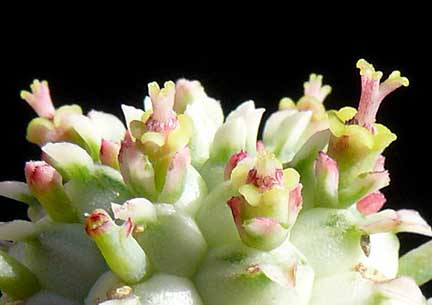
Closeup of the tiny Euphorbia mammillaris variegata blooms.
Finished up Saturday, before yesterday’s rain. All gone.

Unnamed Echinopsis or Echinocereus or Echinocereus x Echinopsis hybrid.

Copiapoa dura, also known as C. echinoides v. dura, is generally solitary, but occasionally forms tight clusters – and we have some that are forming tight clusters, as it so happens. These guys are from coastal Chile and are frost-sensitive.
The species is a bit variable, so there are green specimens with shorter spines. But we like these black ones with the longer curved spines.
Almost fully open!


Echeveria “Afterglow” bloom in profile view.
Another shot of this flower, in full frontal view, after the break. Read More…
Othonna capensis is a succulent in the Daisy family.


My favorite of the blue salvias, Salvia chamaedryoides, always looks more purple in the pictures. I wonder why?

Euphorbia griffithii “Fireglow” looks very similar to Euphorbia “Excalibur” except with a little bit of fire glowing in the sepals. (I mean that it’s orange instead of yellow.)
These will grow to a beautiful 3 feet tall, if you are a good gardener, mostly vertical. Even before the blooms come out, there’s a lot of red in the stems and the leaves. Eventually, the blooms prays will fade to yellow, and then you’ll know winte3r is upon us.
While evergreen, mostly, you can cut these back in winter if you like. They don’t have a lot of real shrubby structure, more like a whole bunch of vertical stems.
Ideal as a deer barrier, they are also an amazing touch of late summer color that pokes up through other more drab shrubs.