Red Rover

Penstemon “Firebird” is hybridized from about half a dozen different plants. Good to know! Prolific bloomer spring through fall, as you can see. It’s common name isn’t really Red Rover, it’s Beard Tongue. Now you know.

They’re a solid perennial, growing to about 3 feet tall, ideal for borders (as they say). You can definitely cut them down severely after the fall blooms are done and they will be thicker next spring, but I usually am lazy about my penstemons and they come back strong anyway. Bay Area gardeners are lucky that way.

Vuurpylaalwyn

Aloe peglerae is one of the most subtly deeply colorful of the stemless aloes. It generally only gets around 16″ across, and ours are full size. But in full hot sun, they tend to close up a lot and look more spherical. They have short bloom stalks with orange tubular flowers.

Endangered and endemic in South Africa, they are pretty rare in the trade. We’ve tried to get seeds from South Africa unsuccessfully, so we were very happy to find a couple specimens. If they don’t all sell this year, we hope to get seed next spring. On the other hand, if you buy two of these specimens from us and are successful with the hummingbird pollination, we’ll buy back the seed! Now that’s a deal.

Kangaroo Paws

It’s been a long day. Here, have a pretty picture.

Anigozanthos “Bush Pearl” is the pinkest of the Paws. And a late bloomer too.

More Blooming Mesembs

Aloinopsis villetii Titanopsis schwantesii

We’re bringing out more mesembs as fast as we can. Blooming mesembs! Blooming mesembs from South Africa!

Tidbit of info for the day: Aloinopsis is named for being similar to Aloe. Yay! Also, they are generally winter growing, like a lot of the South African Aloes. So this is the beginning of their growing season. It seems to like to bloom first, then grow later.

UPDATE: Not an Aloinopsis, of course! But Titanopsis is named for, well, I can’t really say here on this family blog now can I?

Greyleaf Sugarbush

Protea laurifolia “Rose Mink”

That’s a bud. The flower isn’t open yet. Hopefully this won’t sell before it opens and I get a really awesome photo for you of the open cone-flower. And let me tell you, it is AWESOME. Feel the power of the awesome protea cone.

Propeller Plant

One of our gorgeous Crassula falcatas is coming into a vibrant red bloom spray.

image

Whortleberry Cactus Blooms

Myrtillocactus geometrizans

We’ve got some nice sized specimens that are covered in berries, and still more blooms too. The berries aren’t as photogenic as the flowers, but there are 3 berries in this photo. They taste like blueberries.

Fishhook

image

Ferocactus tiburonensis goes crazy with late summer blooms.

Baby Toe Blooms

Fenestraria aurantiaca, moist from being recently watered. Don’t overwater, please. Don’t take this photo as permission to overwater.

Usually these have white flowers, but our crop this year has mixed white and yellow flowers. This is good. However, we thought we had enough to last through the winter indoor gardening season, but they’re selling out pretty quickly around here. We were out for about a year, until this crop was ready, and it may be another year before we have more when this round is gone. Gone!

Butterfly Agave

This must be called the Butterfly Agave because of the shape of the leaves, not because the blooms attract butterflies, since as you can see by this comma-infested sentence, and the picture below, there are bees swarming the blooms on this plant.

There are lots of Agaves in bloom in Berkeley these days (Like this one).

This Agave potatorum is only about 2 feet across and 10 years old, but this is the end for this beautiful specimen. The bloom stalk is about 12ft. tall. You can see how much energy it would take for this giant stalk to come out of this rosette:

And the flowers are kind of nice too. At least the bees think so.

Fan Aloe

We’ve got an Aloe plicatilis blooming out of season, but then the weather has been strange all summer.

Little Rebutia is a Big Bloomer

Rebutia fiebrigii

These have been our most reliable bloomers during this record cold summer (with a couple of very short heat spells.) Here’s a photo of one blooming back in June. Notice the color variation. I wonder if we should hand select these for the different oranges and give them cultivar names? Rebutia “Orange Sherbert” and Rebutia “Orange Ice Cream” and Rebutia “Orange Chocolate Cake”.

Naah.

Unnamed Cactus

This Mammillaria has a lot of blooms. More than is usual, since usually there is a single row of blooms open at any one time, with additional rows along the crown ready to bloom later.

I don’t know the species – any guesses? It has pronounced tubercles, and very bright pink flowers. A little bit of woolly between the tubercles and at the crown. That should be enough to ID it.

Agave Cactus

Yes, that is the common name for this member of the cactus family that looks like it should be in the agave family.

Leuchtenbergia principis is from the Chihuahuan desert and unlike the agave it can bloom and bloom again, every year. Though they do not bloom young, so you may have to wait 10 years to see such a vibrant yellow flower.

Those weird papery spine things on the ends of the arm-like thingys are in fact the spines, true cactus spines, coming off the “arms” which are not branches or stems or even leaves, but what is a tubercule. Cactus are soooo interesting!

They need a tall pot, since they have a big and ruddy taproot.

http://davesgarden.com/guides/pf/showimage/40011/Leuchten

The Elusive Haworthia Bloom

Haworthia reinwardtii

You can’t tell the species of haworthia apart by the bloom, at least not without an electron microscope. They all look the same. Tough to capture on film, too. So here you go, use this photo as an illustration of your haworthia blooms no matter which species you have.

Mexican Hens

Echeveria shaviana

I don’t like that common name above in the title. What a stupid thing. Blah. I wonder if hens even like these plants, since they’re not delicious, but then hens aren’t too picky anyway.

Another picture for you after the break. Read More…

Old Man of Peru

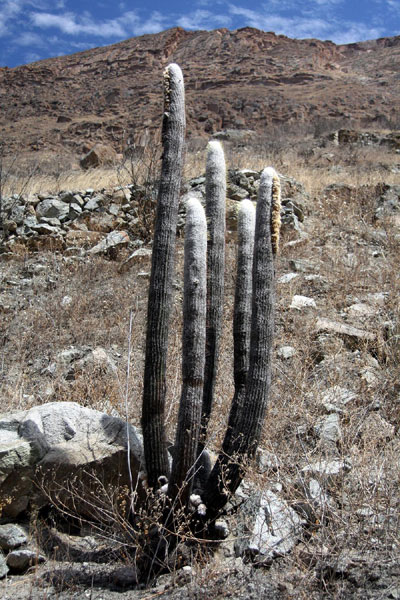
Espostoa melanostele

Our blooms seem to only last a morning, not even a day. I took this photo in the early afternoon and the flower is already starting to close.

The buds are coming out of the lateral cephalium, the woolly area growing along the side of the plant.

You can really see the cephalium in this photo taken in habitat from Cacti Guide, photo by Craig Howe. And what a habitat that is, high altitude plains – looks kind of deserted, kind of desert like.

Golden Milkweed

Asclepias curassavica “Silky Gold”

Every year in the spring I start waiting for the milkweeds to bloom, and every year they won’t bloom for me in the spring. I have to wait for summer! That’s not fair.

Here we have the less popular gold colored milkweed. They’re also called Butterflyweed because they attract butterflies.

This cultivar has very green leaves to go with the deep gold flowers. The leaves darken up a bit in full sun. As far as perennials go, it’s adequate.

Indian Mallow Revisited

So here’s a much better photo.

Abutilon palmeri is my favorite of the native mallows. There are a lot of Abutilons in the nursery trade, and I think they’re over-cultivated for the papery petals. Here we have a species plant and it seems firmer, somehow. More grounded. Certainly not prettier.

San Pedro Cactus Flower

Echinopsis pachanoi

Normally these are wide open. In fact, I’ve never seen them like this, but they all were doing this earlier this summer. This photo was taken 2 weeks ago, before the warm weather, and it appears that it just isn’t going to open any wider. The parts are all there, and the bees are able to find them and get busy and all.

Mesemb in Bloom

Aloinopsis schoonesii in summer bloom. Usually blooms in spring, but with the cold foggy year, it was late.

Click the photo for a closeup of the very bright yellow flower.

A wacky bonsai version of this plant can be seen here.

Rosary Vine

Also known as the Kebab Bush.

Crassula rupestris

From South Africa, specifically around the areas in southern Namibia, the Richtersveld, Namaqualand Ceres Tanqua Karoo, Worcester Robertson Karoo and Little Karoo.

This is the first year we’ve grown this. It looks a lot like the various C. perforatas, but then I haven’t watched it grow for years yet.

They say it is hardy to 25F.

Olulu

Brighamia insignis

These very rare, endangered in the Hawaiian wilds, plant are really nice local houseplants, although somewhat prone to spider mites.

Here’s an article from the SF Chron from a few months ago.

We should be seeing some yellow flowers in the next month. Too bad we don’t have the Hawaiian moth that has gone extinct to pollinate this for us.

Here’s a shot in habitat from arkive.

White Striped Agave

Agave americana v. medio-picta “Alba”

This has been a popular plant, since we featured it a couple weeks ago. We only have 15ga. plants right now, the 5’s won’t be ready for a few more weeks, and there has been a rush on them! We only have 1 left. I wonder why? Maybe because it’s gorgeous. Here it is in a front yard in Berkeley.

Customers say it looks like it’s painted. So I tell them that we paint them ourselves, in-house. Locally painted, I think, is better than having them shipped to Wisconsin to have them painted for us, like those other nurseries around do.

Crown of Thorns

Euphorbia milii “Dwarf Yellow”

It’s Saturday morning and the dogs are playing so I won’t be adding anything more to this post.

Madagascan Caudiciform

Uncarina roeoesliana

The new crop is blooming. Adorable little buggers, about 1″ caudex. Still happy to produce lots of flowers though.

Carpet Squares

Parodia subterranea

I featured this plant a couple months ago on the blog, although we did not have it out for sale at the time. Now we do. And it has kept blooming all that time since. Up to 5 flowers at a time. And all I seem to be able to catch is one open flower. The bees like these parodias.  I like this one too, since it’s not a yellow flower like all the other parodias we have. And it blooms more often, like a rebutia, so what’s not to like?

Hybrid Spurge

Euphorbia “Excalibur”

Taller than most of our spurges, this one will get about 3 feet. I would call that color a chemical yellow. Maybe this one.

Red Succulent

Sempervivum “Red Rubin” is the most popular new sempervivum introduction we’ve had since “Pluto” 2 years ago. Our first crop will be sold through by this weekend I’m sure. Hopefully we’ll have another crop ready this fall, but it takes a couple years to really build up our stocks.

May 2026
M T W T F S S
 123
45678910
11121314151617
18192021222324
25262728293031