Nicole has been busy making succulent terrariums for the holidays.

Every single one gets a mini animal as well as a succulent.

Nice! Anne says the chicken is a snow chicken. I doubt it. It looks like a Rhode Island Red to me.

and Ross Valley Nursery
Nicole has been busy making succulent terrariums for the holidays.
Every single one gets a mini animal as well as a succulent.
Nice! Anne says the chicken is a snow chicken. I doubt it. It looks like a Rhode Island Red to me.
I see the winter growing South African Aloes are coming into season.

Snake head bloom stalk on an Aloe speciosa, the Tilt-head Aloe that will get up to 10ft tall with a single tilted head.

I hope you’ve been able to cover your frost sensitive plants. Two more nights of freezing temps…

The finished product features a rock wall, along with numerous and colorful succulents. Courtesy of Jan Nelson. Read more: Press-Banner – The Mountain Gardener Living wall shouts love at every turn
If you click through you can see the closeups of the succulents stuck in amongst the rocks in the rock wall, the succulent rock wall.
The El Paso Times has an interesting way to illustrate an article about very colorful cactus for sale at a local cactus show.

Learn to grow, care for colorful natives at club’s Cactus Fiesta and Plant Sale
Nice!
But anyway, the sale was last month so you have already missed it. I have fallen down on my job of informing you in a timely fashion of all the latest cactus club sales throughout the greater West Texas region.

Special Centaur in the Garden Edition.
The Conservatory of Flowers in Golden Gate Park has a lot of Nepenthes hanging around, doing their Pitcher Plant thing. In contrast to the orchids, the Nepenthes are not well labeled, so I don’t know what species most of these are. Except for the one fancy fanged Pitcher Plant…

“Nepenthes bicalcarata, also known as the fanged pitcher-plant, is found only in Borneo. The purpose of the fangs has long been debated among botanists. They have been thought to deter mammals from reaching in and stealing the contents of the pitcher, though the more intelligent mammals like monkeys have been observed tearing open the side of the pitcher to get to drowned insects. Other botanists suggest that the fangs, which secrete nectar, serve to lure insects into a precarious position over the pitcher mouth, where they may lose their footing and fall into the pitcher fluid, eventually drowning and becoming food for the plant.” via SF Conservatory of Flowers QR Code.
The rest of these are not quite as spectacular, being without two perfect fangs, but they are amazing, even if the Conservatory did not see fit to name them.


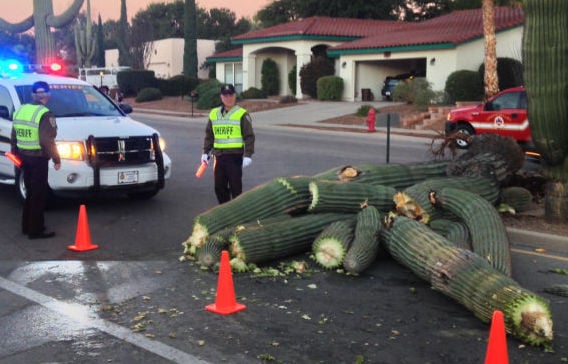
From the Green Valley News Tribune Record and Sun comes news of a broken Saguaro. It seems to have been hit by a car, but probably after it fell. If it fell on a car then the picture would still have the car under the Saguaro.

Pima County Sheriff’s Auxiliary members wait for a cleanup crew to show up in the 1200 block of North Abrego Drive about 7 a.m. Tuesday, in the Country Club of Green Valley. A saguaro fell into the road and apparently was hit by a car sometime in the night, according to the Green Valley Fire District.
Those look like some very shallow roots. No wonder it fell over.
Hi Peter,
I hope you can help me out with an unusual repotting problem.
A well-meaning friend of ours recently sent us a “cactus garden” as a gift from an online website, pictured below:

Any idea what the different species are? The online vendor simply labeled them all as “cacti”.
Well, the various cacti and succulents are doing fine so far, but now I think they are starting to crowd each other out. I was hoping to repot them, but the potting soil that they used is as hard as concrete! I can barely dent it with a hammer!
Yes, it is that hard. I can’t even pull the wood chips out of the soil!
I have no idea what crazy concoction they are using as a soil. The directions that came with the garden only say that, “The cactus soil is a blend of nutrients combined with a hardening compound. It was scientifically developed to provide a healthy growing environment for cactus while also providing protection during shipment. Although it appears hard and impenetrable, the soil does absorb water and distributes it throughout the planter.”
Have you ever run into this strange potting medium before? If so, are the poor plants going to be okay in that stuff as they grow? And if not, what is the best way to get them out safely so that I can repot them?
Finally, it is currently winter here in southern California, and the cacti are sitting outside on our back porch. Should I wait until the spring growing season before attempting to repot them? And how much space should I give them?
Thank you for all your help!
Sincerely,
Jonathan
Jonathan,
You have 3 cacti and 3 succulents. This type of potting is not intended as a long term solution, so yes they do have to come out of the concrete (and they do add gypsum, i.e. concrete, to the mix to get it to harden). So basically you will be rescuing the plants.
If they are healthy now, I would wait until spring. If they look desperate, then go ahead and get them out now.
I don’t have any secrets for rescuing them – get the whole thing out of the pot and chisel them apart as best you can trying to save some roots where possible, but allowing for the fact that these may be cuttings you are starting with once they are out.
Pot them in dry fast-draining cactus soil, keep dry for a couple weeks. I would try a 4″ pot for each plant, if I am judging the size correctly.
Succulent Species:
Crassula ovata (Jade)
Faucaria felina (Tiger Jaws)
Pachyphytum, maybe longifolium
Cactus species:
Cleistocactus strausii
Mammillaria
Parodia
Peter
It doesn’t look good for Israel’s National Fruit, imported from the Americas a long time ago. Hint: It’s a cactus.

Israel’s Iconic Sabra Cactus Endangered by Invading Aphids
Israel, being on the “land bridge” that links it with Africa and Asia Minor, has always been well known for a number of biblical fruits….
Now, this national plant symbol is being threatened by the invasion of a species of parasitic aphid that has been attacking Sabra cactus plants in the far north of the country and threatens to spread over other parts of Israel as well….
Sabra fruit is harvested in late summer and is often sold in roadside fruit kiosks in both Israel and in the Palestinian Authority. The fruit is best served chilled and it is recommended that one wear gloves when peeling them to avoid being stuck by numerous cactus spines.
Excellent advice.

Aloe Hill at the Conservatory of Flowers in Golden Gate Park is looking fine this time of year.


And a bonus Agave too.

The Times Herald Tribune Record prints interesting cactus questions from their readers.
Q: What is the difference between a Thanksgiving cactus and a Christmas cactus?… — Sara, Eldred
A…. The Thanksgiving cactus generally begins flowering in mid- to late November and continues into December….
The Christmas cactus normally begins to flower about Christmas and continues flowering into January.
That was easy! I could answer newspaper questions too! Someone, quick, get me a column! I want at least 25 column inches every week!

Normally the California Native Lewisia cotyledons bloom in spring and summer, but we do always have a few that will bloom at other times of the year, like now.
In fact, we find that as these plants mature they can bloom up to 6 times per year! That’s a lot of blooms. You just have to dead-head them to prevent them from going to seed in case they were pollinated. If they go to seed then they are done blooming for the year.

Bonus picture of an Owl after the break… (more…)

That Agave shawii and it’s red tipped spines. Nice!

Oregon Street, Berkeley
Prickly Pear, maybe Opuntia saxatilis, though it would be hard to know for sure until it blooms. Plus a bonus Aeonium “Schwartzkopf”.

4th Street, Berkeley
Kniphofia in bloom

All the brightly colored Christmas Cactus are out, and not a day too soon.

These are all hybrids from Brazilian species. Nobody knows anymore what the original species from the jungles were, but we like to think they are hybridized from Schlumbergera orsicchiana, which tend to be pendant and epiphytic.

All those green segments that look like leaves are really stem segments, and the cactus spines, as these are true cacti, come from the joints between the segments. The segmenting of the stems makes for easy cuttings.

Some would call these hybrids something along the lines of Schlumbergera orssichiana x truncata, but the truncata part of that was long ago gathered into Zygocactus, but then put back into Schlumbergera in 1967. So if you see these advertised as Zygocactus you should know that they are archaically sticking to the early 60s. Old people today.
It’s a Thanksgiving Day treat-ball Miracle!

Robert sends along a photo of Lisa’s Thanksgiving table with our Succulent Wreaths for centerpieces, with red candles!

The Arizona Desert Sun has an article about planting naturalistic plantings next to modern lined out plantings and they use this photo as an example. I find that odd. Here’s the caption that goes with it.
This view shows the naturalistic plantings beside the grids of golden barrels proving a combination of both may be the most sustainable design solution. / Maureen Gilmer/Special to The Desert Sun
I don’t understand where the naturalistic plantings are that are near the grid of Golden Barrels? Is it the lawns? The square pathways? What is this article talking about? The random Cleistocactus or the random tree placed among the barrels? Who knows. According to the article:

A landscape that depends on one species to establish its primary visual character may appear profoundly beautiful in its simplicity. These monocultures are all too common in many of the contemporary landscapes I’ve seen throughout America. I study them closely to keep up with design trends for new and restored, modern and mid-century home landscapes.
Ahhh, now I understand. The writer is using the word “naturalistic” to mean “not a monoculture.” Interesting!
And the picture is nice!
Here are two very nice Parodias. Parodias are known for their yellow flowers, although not all Parodias have yellow flowers, but there is a yellow color known as Parodia Yellow so you can imagine that they are well-known for their yellow flowers.
Many people will argue over the shear number of Parodia species, even though many or most are really subspecies of only about 65 species.
Native to the South American Highlands. And Lowlands too.

First up is Parodia mueller-melchersii ssp gutierrezii, one of those cacti that have been wrongly categorized as separate species over the years, more recently known as Notocactus gutierrezii, a name that some cactus growers cling to out of tradition or anger or for the shear spectacle. Native to the Rio Grande do Sul in Brasil.

Next is the very attractive and slightly more common Parodia nigrispina, originally in the 19th century assumed to be part of the Echinocactus genus, but that’s ridiculous. These hail from the fine country of Paraguay, which I believe is in South America.
Kind of a very vibrant red against a sky blue backdrop, if you choose to photograph it that way, which I did because this particular Paws has very tall bloom stalks so it is hard to photograph it against the foliage way down below. Instead shooting up towards the sky works well.

Anigozanthos “Big Red”
Australia
Evergreen Shrub
Sun: Full Sun
Water:Moderate in Summer
Size: 4-6ft. tall
Vibrant fuzzy tall red flowers,blend well with red stems in Spring and again in Fall. Long lasting blooms are perfect for cut flowers. Hardy to 20F.
It’s the new Orchid colors, just in time for Thanksgiving. You will have to choose the right color for your T-Day table. If you pick wrong, your Aunt May will berate you.
Choose wisely.
And we’re off!!!!


These all were Phalaenopses, by the way.
Our friend, Benjamin’s litter-mate, Whylie passed away yesterday. Here’s some reprints of the whippets.

Whylie

Whylie in the middle with Benjamin and Jason

This one is from 2006, the two brothers. So handsome!
Cactus are just like any other exotic plant – they can become invasive and a pest. In Africa there were Opuntias that were planted for the fruit and the flowers and now they are killing the local livestock.
The National Environment Management Authority has said it will issue a licence for the release of an insect that will feed on a cactus that kills their livestock in Laikipia county….
Wahungu said there are set procedures to be followed to release the insects as they have never been used in Kenya. He cautioned that this will be an experiment and any biological release can bring unexpected repercussions. Wahungu said they will not leave anything to chance.
The residents led by Laikipia North MP Mathew Lempurkel said they have lost thousands of livestock after they feed on the fruits of the opuntia type of cactus, which have sharp tiny thorns that damage the intestines of the animals leading to death.
Unfortunately I am skeptical of this type of pest eradication effort. I don’t think it will end well.
A new bird comes to Berkeley, and the birders rejoice.
This weekend, hundreds of bird enthusiasts flocked to a quiet southside Berkeley neighborhood to catch a glimpse of a beautiful North American breeding bird that has never before been sighted in Alameda County. The colorful Painted Redstart was still in the Elmwood neighborhood this morning…
“It has a distinctive call that sounds like ‘too weet’ with the emphasis on the ‘weet,’” (Lory) said.
We’ll post anything here at Berkeley’s own Cactus Blog.

First we have a profile shot of the very attractive flower of the:
Calystegia macrostegia “Candy Cane” – California Morning Glory
California Native
Herbaceous Perennial Vine
Sun: Full Sun near coast, Afternoon Shade inland
Water: Moderate, deciduous in summer if dry
Size: Twining Vines
Long lasting colorful blooms for a good part of the year. Great for climbing on fences. Keep watered through the summer to keep green.
And then we have a head-on shot too.

If you click the link above you can see another picture with both a head-on and a profile shot, togethewr in one amazing picture. Calystegia macrostegia California Morning Glory
Want to know how fast some Aeoniums can grow?
Check out the before and after photos at Bamboo, Succulents and More.
That’s a lot of growth!

Is it art? Is it a cactus? Is it a bird-flipping?
RIVERTON – Maybe it’s a hand flipping the bird – or it could be a cactus.
For three families, it’s just another dispute in a yearlong battle over a house being built along Reeves Lane in this southwest Salt Lake Valley community.
Owner Darren Wood described the vent covering placed Monday as decorative “abstract art” and a “cactus.” But his neighbors uphill say it’s a hand flipping them off.
“This kind of shows the attitude that we’ve been dealing with all along,” said Stan Torgersen, who added that the gesture is visible from every window on the back of his house….
That was an old article, from 2006, as seen on Balloon Juice for some reason.

Yesterday was a how to for succulent wall panels. Today we present Succulent Terrariums. But I can’t really explain all that well in words how to make them. You know, you plant some succulents in a piece of glass. Add some charcoal at the bottom, and some toys on top. Woohoo!

And a big and fancy succulent terrarium, although it’s hard to tell from the photo how much bigger it is than the others above.

If you look close, you can see a little dinosaur there, and you can compare it to the one in the top photo for size.