
Friday Whippet Blogging

and Ross Valley Nursery
This one when it was little we thought was Aeonium tabuliforme, a very large dinner-plate sized flat semi-stemless rosette. And then it grew up and no longer looked like that. It’s still very flat, though. I wonder what it could be?

Aeonium pseudotabuliforme – yes, that’s right – that’s the name. At least it means we weren’t so far off in the first place.
Cactus and succulents come to Ohio, by way of Minnesota, via Ohio.com.
Dry gardens were all around us last week, as a group of Ohio State University horticulturists traveled to the Minnesota Landscape Arboretum just outside of Minneapolis as part of a teaching and studying tour.

A succulent planting at the Minnesota Landscape Arboretum. (Denise Ellsworth/OSU)
Q. Do jumping cholla cactus really jump?
A. Yes.

Photo Chaz Kasanicky
I may have cut their answer a little bit short. You’ll have to click through to see the rest of it. And if you do, don’t blame me for changing the meaning of the answer by cutting it short – it’s not my fault.
…on our yelp page.
if you need a cactus, u need to go to the cactus jungle. cool place and great staff. thanks for the help Ian.
Keith got one too, but they called him Kevin by mistake.
Today we feature 2 smaller rosette aeoniums, that grow about 3ft. tall and are very branchy.
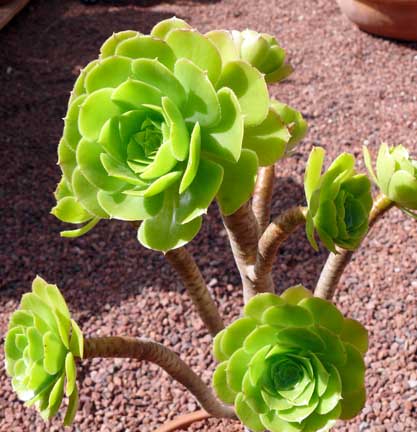
Aeonium holochrysum

Aeonium balsamiferum
Now we started with a crop of the holochrysums, and then when those were big, we bought another seedling tray of the same thing. When they were big enough, we potted some and sold the 2nd tray as holochrysums also. But when the rest grew bigger we realized they’re not the same plant. I’ve decided the 2nd plant is balsamiferum. It’s also possible they’re the same species, but different cultivars or subspecies.
But they look different enough to me that I can’t in good conscience call them the same plant.
Also, these are summer photos, when the rosettes are at their smallest. In the winter they’re a lot more full. But interestingly, these 2 shrink up more than a lot of our other aeonium species.
The SF Chronicle raised their price again, to $1, after recently shrinking the paper by 1/3.
The future belongs to the internet. Blogs rulez.
Yesterday we looked into some varied subspecies and cultivars of the A. arboreum. Today we look at a very confusing distinction between 2 very similar plants.

Aeonium canariense (or canariensis)

Aeonium subplanum
Some say these are the same plant, synonyms even. Others claim one is a subspecies of the other. I don’t know. What I do know is they are both large, low growing, green aeoniums, with pink-tipped leaf margins in full sun. However the plant we are calling canariense is taller, while the subplanum is broader (the photos make them look the same size, but the subplanum is actually twice as big across). Also the canariense leaves are fuzzier while the subplanum leaves are glossier. And the pink tinges on the 2 are slightly different colors.
Country Living magazine wants you to know that succulents make a good addition to any container garden, if you live in the country. I suppose we should check with City Living magazine to check out succulents in the city.
A friend collects animal-shaped pots such as chickens, goats, pigs, bunnies…
I love bunnies! I wonder if they also collect turtle shaped pots. I love turtles!
(C)onstruct hypertufa troughs from… cat-litter trays as molds….
I don’t think so.
One of the great things about succulents and cacti (on which I dote) is that they can live in very small pots for a very long time.
That is true, but not forever.

While puttering with my succulents and cacti, I reminisce about trips to Nice or Cancún.
Now that’s just the capstone on the concept.
NPR has the report. From 89.3 KPCC
Nopalitos: taming the prickly pear cactus.
Blogging is easy when you have a subtly translated email to share.
Hello, how are they?
Since we are in a period of holidays, do not forget to suggest a visit to the Festival of Gardens in Ponte de Lima, and noted that the entries for the next edition are open until 31 October. For more information, see the site.
“Kaos in the Garden” is the theme of the 2010 Open.
I wish for good holiday.
Regards,
City of Ponte de Lima
It’s very confusing, all the different types of aeoniums. For instance, the popular “Schwartzkopf” is a cultivar off a subspecies off a species. So it could be properly called Aeonium arboreum ssp. atropurpureum c.v. “Schwartzkopf”. And then we have our own cultivar off that! very subtle differences.
Here’s our current list starting with A. arboreum.

Aeonium arboreum
more… (more…)
Apparently the new eco-conscious gardener in Australia is planting succulents to replace their old fashioned cottage garden.
Yay!
Hi Hap,
Thank you very much for identifying my strange plant. No wonder my searches for native and indigenous Lanzarote succulents didn’t get the results I wanted. Google has found good pictures of thisice plant, and I can’t wait for mine to flower and fruit.Your history resume of the plant is very interesting, and it fits in with where I got the seeds. The castle on the volcano rim dates back to the 1500’s, and overlooks the (then) island capital Teguise. Lanzarote was an important stopoff on trade routes of the time from South Africa and the New World. San Antonio, Tx. was later founded by Lanzarote emigrants.
Maybe my little plants have been naturalised on the side of that windy volcano for 500 years before coming to a less-than-ideal UK climate?
Cheers,
Phil
Hap gets right to it and identifies a mysterious, though fairly common, mesemb.
Hi,
I’m wondering if yourselves or any of your readers can help identify this plant from Lanzarote in the Canary Islands. When I collected some dried fruits/seed pods in Sept ’04 I took a picture of some still succulent fruits, which look a bit like raspberries, with red and colourless ‘cells’. The seeds were in the black pods in the centre of the fruit.
I came across the seeds again this spring, and they’ve proven viable after almost five years. The plants are a few months old now, about 2 inches tall. The biggest leaves are roughly 2 inches long, fleshy and rubbery with clear cells on both sides of the leaves, the undersides having bigger cells.
Please see the attached pictures to help identify this plant, and if anyone’s interested, here’s where I collected the seeds.
Cheers,
Phil
Cool map. Hap seems to think he knows what it is. Do you agree?
Phil,
It looks like you have Mesembryanthemum crystallinum, an interesting “ice” plant native to South Africa. It has naturalized all over the world, in both temperate and Mediterranean climates. It is so wide spread because it is a quick growing, salt tolerant plant that could be grown in pots for both cheerful flowers and edible fruit and “greens” for cooking that was useful as a treatment for scurvy. So sailors traded seeds and plants all around the world and even grew it aboard sailing ships. It is believed it made it to the Americas on those early sailing ship in the 1500s.
Hap
I thought it was too hot in Phoenix for most succulents, unless you had a lot of shady spots. The newspaper begs to differ.
Stylish succulents can thrive on neglect
One large succulent in a pot makes a dramatic garden on its own…
You can infinitely mix them in potted arrangements…
(S)wag them from the balcony…
These are good ideas. I would add:
-Drip them from the drain pipe…
-Dangle them from the garage’s gutters…
-Pop them out of your car’s cup holder…
-Arrange them in shapes like circles, pentagrams and dodecahedrons….
-Glue them to the kitchen wall beside the refrigerator. You know the spot, where Sue threw the dishes at you and missed last week and they smashed against the cupboard leaving a bit of a dent in the plaster work – that spot.
On the Gates arrest, this post by Digby is very good. As they say in the intertubes, “what Digby says.”
My personal perspective is colored by the fact that I was also once arrested for arguing with an officer, even though no laws were broken and no charges were filed. There’s no question they have power beyond upholding the law.
You read that right, they’re making patented hog feeds out of cactus in China.
China to Launch Patented Cactus Hog Fee
Over 65% of all meat consumed in China is pork….
The cactus hog feed market shows huge growth potential….
Studies have shown that Kangtai’s cactus feed substantially increases productivity…
I wonder when they’ll be marketing this special hog feed to the American market? Our pigs could use healthy natural feeds. And then they’ll have to come to me to supply all their cactus, since there are a lot of hogs that need feeding.
In Phoenix, the Cactus Doctor apparently gives away free cactus, according to ABC15.

David Mills
The Cactus Doctor stands next to a 6-foot saguaro he just transplanted in his nursery.
I’m skeptical. The report actually tells you to go to your local nursery and ask for free giveaways, discarded plants. That’s crazy talk.
Anything we discard, we give to a school or nonprofit.
Jason has had his stitches out, so he’s no longer Cone Boy.

Long Live Cone Boy!
These are among the more delicious of cactus fruits. Scripps News has the whole thing covered.
Among the most promising fruits for arid-zone American gardens is the apple cactus, Cereus peruvianus. This large, branching treelike columnar cactus produces some of the most delicious and beautiful fruits for gardens….
Due to the fact that the apple-cactus fruit does not have spines or glochids like that of the common prickly pear, it makes a far better residential fruit plant….
Whether you live in city or country, apple cactus is a great choice for drought-ravaged regions.
This article mentions that they are pollinated by bats, but only in passing. In fact, these are the notorious night-blooming cereus. The blooms are open one night only, so you have to have more than one plant happen to bloom the same night, and then you have to have bats. Now here in Berkeley, there are plenty of bats, but only up in the hills and not down here in the flats where the nursery is. So we do not get fruit. This is a problem with urban areas.
So I disagree with the conclusion that this is a good fruiting plant for drought-ravaged cities.
The LA Times has finally featured a full exploration of the phenomenon of planting cactus and other succulents in beer cans, a classic american trope if ever there was one, although the little umbrella is more of a mediterranean touch.

Inman recycles all-American beer cans as planters for the low-water sculptural plants, starting at $8 apiece. She also turns more elaborate cactus and succulent arrangements into what she calls “narrative scenes with animal figurines, cast iron statuary or modern design elements” that start at $30. Inman can be found most Saturdays at Silver Lake Art Craft & Vintage.
The other pictures in the article are more, shall we say, whimsical.
I got a venus fly trap a while ago from you guys, but it hasn’t rained here in the bay area for a while, and I’m really tired of driving to a super market paying 50 cents per gallon of distilled/ RO water. Do you have any tips for saving water? Does adding long fibered sphagnum moss work?
Michael,
We find that East Bay MUD Water is PH neutral enough to use with our carnivores… as long as we add a pinch of grape pomace to the pot every now and then… Vinegar at about a teaspoon to a gallon of water is also said to work, but I have not tried it on carnivores, just acid loving orchids.
Good luck,
Hap
And for those who were wondering where you can get this special MUD water that Hap mentions, it stands for Municipal Utility District. In other words, it comes out of our faucets, but not yours.
Are you friends with the Ruth Bancroft Garden yet?
In Phoenix, where the city can’t afford to finish a project that’s been years in the making.
Workers finished renovating Tovrea Castle in June, but it could be up to a year before the 1931 wedding-cake-shaped building is open to the public, city officials say.
That possible budget hurdle is the latest plot twist in Phoenix’s 20-year odyssey to acquire the landmark and 44 acres around it.
At least the cactus are getting watered in the meantime.
We missed this year’s stinky arum at the Huntington.

Click through for the video and all the pictures and the t-shirts, and even to buy one of your own. Plus – they get questions!

Burnett St.
Agave americana v. marginata

Delores Sgambati stands next to her Century plant that has started flowering in her yard.
They’ve found that cactus help keep ticks away from livestock. I’m not really sure how this works, but here’s the evidence.
Researchers at the National Agriculture Research Institute (Naro), who have been undertaking a study on effective control of ticks using botanical solutions, said the cactus shrub has spikes which put off ticks from climbing farm fences to bite animals.
No species name. It’s not even clear to me if they mean an actual cactus, or a spiny shrub that they call the cactus shrub.
Scientists found that ticks do not like the cactus because animals naturally do not go near the plants, but also due to their spikes that make their environment uncomfortable.
But the veterinarians have found that when crushed and mixed in water, spraying it on animals kills all the ticks just like conventional acaricides.
Now that is really interesting. If only it would work on aphids, too.
In Galveston, they have some very apropos advice.
(S)ucculents should not be watered as often as most other houseplants.
That’s quite good. But what about specifics? Do you have any specific advice for your readers?
The frequency of watering is determined by the plant species, composition of the potting mix, environmental conditions indoors and time of year.
In other words, no specific advice at all. Bummer, dude.


