You can’t tell the species of haworthia apart by the bloom, at least not without an electron microscope. They all look the same. Tough to capture on film, too. So here you go, use this photo as an illustration of your haworthia blooms no matter which species you have.
A Nipomo (CA) man who grows and markets edible cactus nationwide believes its value soon will be discovered by U.S. consumers as well as those working to help poverty-stricken countries.
“This plant could save the world,” said John Dicus as he gave visitors a tour of his Rivenrock Gardens.
But how should we eat this cactus that you sell?
Dicus offered visitors a taste of his own recipe for cactus salsa.
A mix of beans, corn, tomatoes, onions, cilantro and cactus chunks that look like chopped broccoli stalks, the salsa has a unique flavor but doesn’t scream “cactus.”
“Cactus should be seen as an herb, where it doesn’t really overwhelm the salsa,” he explained. “It’s been compared to green beans. It should be mixed in as an overall ingredient.
That’s practically a recipe. And what do you know, there’s a whole recipe page too. Now that’s service.
And where is this so-called Nipomo? Southern Cal of course.
For the 2 aeoniums, something is eating them. Possibly slugs, but there appears to be whole bites out of the A. “Sunburst” so it could be mice or deer as well.
Other than that, they have gone dormant for the summer and will perk up as we get into winter and they start growing again.
The bromeliad, on the other hand, looks like heat stress. We’ve had a couple days of sudden heat in the Bay Area recently, including a 35 degree rise in 2 days. We’ve noticed a lot of plants have been affected. Basically, it’s going to need to grow out of it, but you may want to try a little extra water for it, including today which should be pretty warm. Liquid kelp could also help.
OUR ANSWER: Gosh, Lyn, this question sure takes us back in time…
When Tranquille Institution closed in 1985, the inevitable happened: the gardens slowly and sadly fell into disrepair as the property sat dormant. “The once-beautiful gardens were taken over by wild grass and weeds,” said our own avid history buff and editor of The Daily News, Mel Rothenburger. “Shame really.”
And… here’s a classic photo to go with it. If that link doesn’t work, go here and do a photo search for this: I-51949.
So it turns out that Tranquille was the name of a Sanatorium. Clever. I love the provincial photo archives.
Wendell “Woody” Minnich is the featured program presenter at the Chinle Cactus and Succulent Society’s Sept. 9 meeting.
His program will focus on his experiences in the Rio Grande Do Sul, the most southern state in the country of Brazil. The public is invited to attend the free presentation at 6:30 p.m. in the Community Building at Mesa County Fairgrounds.
“This seldom-seen region of Brazil is rich in cacti, bromeliads, succulents and other unusual plants and animal, fascinating birds and where many of our most well known cacti are to be found,” Minnich said.
I don’t like that common name above in the title. What a stupid thing. Blah. I wonder if hens even like these plants, since they’re not delicious, but then hens aren’t too picky anyway.
Succulent plants that were so trendy during the 1970s seem to be gaining popularity again.
If you live in San Jose, now you know! For everyone else, you can be proud that you were ahead of Silicon Valley on this curve. And what’s with the passive voice anyway? The reporter should get out there and determine for themselves the truth of the proposition, or get off the can.
Any other cranky things I can add? I can add the info for an upcoming Southbay class being offered:
“Gardening with Succulents,” with master gardener Laura Balaoro and the Guadalupe River Park Conservancy… takes place from 10 a.m. to noon on Sept. 11… at the Guadalupe River Park and Gardens Visitor and Education Center, located at 438 Coleman Ave. in San Jose.
Sometimes people come up with questions that we can’t answer. Maybe you have an answer for Rich?
Hi. I’ve been exploring your blog and web site. Very informative. I’ve been volunteering at SD’s Balboa Park Desert Garden. As a public park, it gets damaged at times. There are large plants where people have etched their names on the cactus arms. Names appear brown against the cactus’ green. Do you know of a product I could purchase to paint over the names and restore some of the green to the damaged part of the plant?
Thanks, Rich
Rich,
I don’t know of any product that will do what you want. I’ve seen people use a green sharpie, but it usually ends up looking worse. If you invent a product, let us know and we’ll carry it.
Peter
Our blooms seem to only last a morning, not even a day. I took this photo in the early afternoon and the flower is already starting to close.
The buds are coming out of the lateral cephalium, the woolly area growing along the side of the plant.
You can really see the cephalium in this photo taken in habitat from Cacti Guide, photo by Craig Howe. And what a habitat that is, high altitude plains – looks kind of deserted, kind of desert like.
Every year in the spring I start waiting for the milkweeds to bloom, and every year they won’t bloom for me in the spring. I have to wait for summer! That’s not fair.
Here we have the less popular gold colored milkweed. They’re also called Butterflyweed because they attract butterflies.
This cultivar has very green leaves to go with the deep gold flowers. The leaves darken up a bit in full sun. As far as perennials go, it’s adequate.
It’s Lauren’s first time getting a photo on the blog. Here we see she has taken a classic picture of a particular angle whereby the succulent in question is made to appear to be heart-shaped. A valentine’s gift in September.
Abutilon palmeri is my favorite of the native mallows. There are a lot of Abutilons in the nursery trade, and I think they’re over-cultivated for the papery petals. Here we have a species plant and it seems firmer, somehow. More grounded. Certainly not prettier.
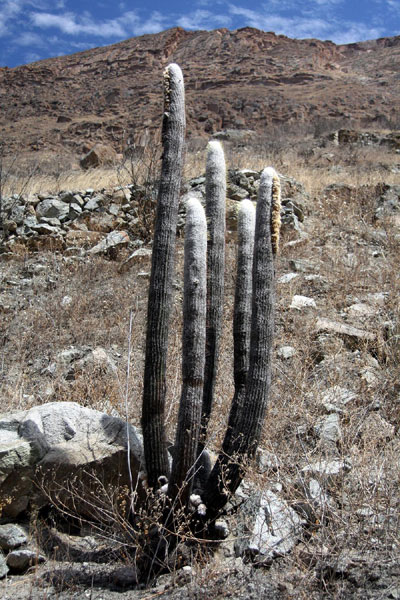
From a website called Today comes a bloggable photo.
A lone cactus stands on the vast, empty hills of the Andean Altiplano.
The article may be bloggable too, but I didn’t read it, so I wouldn’t know. If you think I should go ahead and read the article and write something about it, let me know in the comments.
Normally these are wide open. In fact, I’ve never seen them like this, but they all were doing this earlier this summer. This photo was taken 2 weeks ago, before the warm weather, and it appears that it just isn’t going to open any wider. The parts are all there, and the bees are able to find them and get busy and all.
The photos Matt sent were corrupted (I wonder who did that, and if it hurt?) but the letter is a fine blog item anyway. I’ll let you all know if Matt sends along any photos later.
Hola,
I have a melocactus, my second one actually. The first sadly died early
spring in a weird brown rotting/rust/fungus event after a long winter.
Granted it wasn’t in the most drain worthy pot…but I did take good care of
it and watched it closely. (see striped pot photo). It is deceased now.
Anyway, I read somewhere that transplanting Melocactus is not a good idea
after maturity or something like this??? The striped pot one was
transplanted right away after I got it.
It didn’t fare so well after a year of warm filtered greenhouse light, and
well draining soil.
Anyway, the new one (green plastic pot attached )seems to be wanting a
transplant, although im waiting to do so due to past experience.
Any truth that transplanting a Melocactus is a bad idea or am I just a bad
Melocactus owner?
THANKS
Oh yeh, Matt from PDX
Matt,
I can’t get your photo files to open, they seem to be “corrupted”. Could you please resend?
Melocactus are a bit fussy and easy to lose. I killed them regularly until I saw them growing on the beach-side cliffs of Saint Martin and realized they were tropical cactus and need to be kept warm in winter. Since then I have much better luck, at least if they don’t get forgotten and left outside after summering in the sun…. They turn to mush if too cold, even if kept dry. Since I haven’t seen the photos I can’t tell if you should repot or not, but I have repotted adult Melo’s just fine, by keeping them dry and warm after the root trauma.