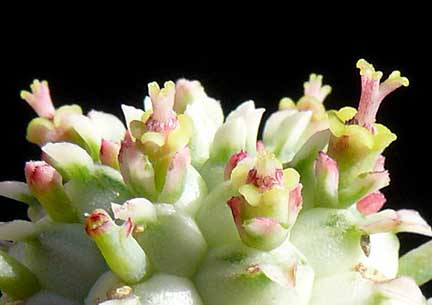
Closeup of the tiny Euphorbia mammillaris variegata blooms.

and Ross Valley Nursery
Closeup of the tiny Euphorbia mammillaris variegata blooms.
All Andrew’s Plants has some Echeveria and Aloe blooms that are full and colorful and were almost ready to open this past weekend. Maybe they’re already open!
In Capalaba, QLD there’s a garden that just blows away the local neighbors. It’s Anne’s garden and she is so much in demand she opened her garden to tourists this past weekend. I hope they had a lovely garden party for all.

Avid gardener Anne McBurnie (opened) her Capalaba garden (last) weekend. Bromeliad gardens are featured on Anne’s property. Photos: Chris McCormack
From Anne’s grandmother’s garden came the cactus and succulents. But if you were there, you also got to enjoy this:
Entry fee is $7 and includes a Devonshire tea on the shaded back porch.
Outstanding.
8 foot plastic cactus is up for auction in the Hudson Valley.
I’ll be there! How about you?
SPECIAL: Approximately 15 lots from the original Broadway production of the “Producers” including Russian Ural motorcycle w/sidecar, stage piano, stage side cabinet, 2 water coolers, various other pieces – not to mention the 8 foot plastic cactus.
I love that show! It’s a steal, at half the price!

Finished up Saturday, before yesterday’s rain. All gone.

Unnamed Echinopsis or Echinocereus or Echinocereus x Echinopsis hybrid.
Sprout Home Chicago puts them in dancing pots.
I assume that refers to the rounded bottoms. I wonder how well they drain?

More photos at Sprout Home.
Oops, I forgot to post this, but in about an hour there’s a succulent container class in Lake Forest, CA, if you happen to be over there, that is, at the last minute and needed something to do.
at Living Green Nursery, find out all about succulents with horticulturist Erick Lux, and learn how to design and plant succulent container gardens with Dee McCartan. Then after class, you are invited to build your own succulent container at the nursery…. Join us Saturday the 16th at 10:00 am
If you missed out on the class, Lake Forest is also famously proud of their July 4th parade, and that’s still coming up in a few more months or so.
…on Gardening Gone Wild, and on her own blog too.
Q: Where might I purchase some of the Guatemalan folk art buildings you used in your containers book (p 196)?
A: The little terracotta buildings are from Miranda’s, a Mexican import store in the Old Town district of San Diego (2548 Congress St.). Unfortunately, they don’t sell mail order, nor do they keep a consistent supply in stock.
Well that’s not helpful to those of us who don’t live near San Diego. But wait! There’s more!
But any dollhouse-sized building will work, so long as it’s waterproof—like this little New England-style church that was originally a Christmas ornament. There are all sorts of wonderful tiny accessories for miniature landscapes.
I can tell you that most of the cutesy ornaments at the local craft stores around here are not waterproof. So be wary.
Two Green Thumbs is one mail order source
That’s just darling...
Thanks Debra!
Hello
I came across your blog whilst trying to find more information on my cactus and i was wondering if you could help me? Ive had this cactus now for about 8 years and i really want to find out what type of cacti he is. Ive done some research and ive been told he is a Austrocylindropuntia subulata monstrose (I think i will stick to calling him by his name Flump). But there are also different types of Austrocylindropuntia subulata monstrose from what i belive and i was wondering if you could help pinpoint exactly what he is so that i am able to give him the best care.

Right now i have him in a small pot ive repotted him twice but he seems happy and seems to be a slow growing cacti (but i could be wrong and just not be giving him what he needs) I have attached a picture of Flump any help would be so much appreciated !
Ben
Now, the funny thing is both Hap and I answered the question at the same time, not knowing the other was answering too.
Here’s my answer:
Ben,
You do have the name right for your cactus. Its common name is the Christmas Tree Cactus, but we prefer Flump. I’m not aware of any other cultivar names for this plant, but an older species name that has fallen out of use is the Opuntia exaltata monstrose.
Peter
You can check out Hap’s long form answer after the break. (more…)

Copiapoa dura, also known as C. echinoides v. dura, is generally solitary, but occasionally forms tight clusters – and we have some that are forming tight clusters, as it so happens. These guys are from coastal Chile and are frost-sensitive.
The species is a bit variable, so there are green specimens with shorter spines. But we like these black ones with the longer curved spines.

Almost fully open!


Echeveria “Afterglow” bloom in profile view.
Another shot of this flower, in full frontal view, after the break. (more…)
Othonna capensis is a succulent in the Daisy family.

Apparently there’s a whole subgenre of postcards detailing disasters in the desert, including dessications and dromedaries.
This card is a cactus careening into a car, a career-ending caper if ever I cared.

From Brain in a Jar.
I can see it’s going to be a slow day at the nursery, mid-week mid-october and hot. So here’s the deal. Come by the nursery today only, and mention this blog post, and we’ll give you…
Double Punches on your Frequent Buyer Card!
25% off Terrarium glass bowls and all watering supplies – wands and hoses.
OK, so it’s just me and Ian here, so I better go let Ian know I’ve just made this offer to you.
Now if you know anything about me atall, you know this is outrageous behavior for me. I’ve never done anything like this before! Oy.

Did you ever wonder what the plant they make absinthe out of looks like? Artemisia absinthium looks like this!
And you can grow it if you want. Shrubby to 3 or 4 feet tall, and easy to propagate from cuttings in the spring, it also doesn’t need to be watered very often. Now that’s service!
Now they tell me that if you extract the oils, wormwood can get very poisonous, and yet people use the dried leaves as a tea for stomach upset. So who are you going to believe?
And the winner to the Aloe question contest is…
Congrats, and all.
Now, do we think he’s going to pick a birdfeeder or a water wand for his prize?
Our contest to help answer the question about a cute little aloe is ending today, so here’s your last chance to be brilliant in public on someone else’s blog!
This may be one of the prizes – you never know!

A 1999 Dodge Caravan!
No, it’s not the prize. But wouldn’t that be exciting!

My favorite of the blue salvias, Salvia chamaedryoides, always looks more purple in the pictures. I wonder why?
In case you didn’t know, Palomar College in San Marcos (CA) near Oceanside, also known as North of San Diego, has a cactus garden, and it’s well tended by a volunteer. Also, the local newspaper there is called the Telescope.

Media Credit: Deb Hellman
One of the flowering cactuses in the college’s extensive cactus and succulent collection tended by Richard Henderson year round.
Hi Peter: We have visited you numerous times and purchased pots and many plants, and wondered if you could help us determine what is wrong with our succulent and what we might do about it.

We noticed it looking a bit lighter color, and when I looked closer I saw what looks like fungus around the bottom, and it looks sort of furry in places and shiny in other places. We had used your Cactus Meal on it several months ago, and the pot is very dry at this point. I have attached four pictures. Any ideas?
Thanks, David & Heidy
David and Heidy,
I’m sorry to have to be the one to tell you this, but it is too late to be able to save your Euphorbia.
It has a fungus, and probably a virus as well which appears to have traveled throughout the plant already. There is nothing I can suggest to help it at this time. I don’t know what caused the problem, but sometimes these things just happen. Probably the virus came first, and that made it more susceptible to the fungus.
Do not reuse any leftover soil, and if you want to reuse the outside pot, you will need to bleach it first.
Peter

Euphorbia griffithii “Fireglow” looks very similar to Euphorbia “Excalibur” except with a little bit of fire glowing in the sepals. (I mean that it’s orange instead of yellow.)
These will grow to a beautiful 3 feet tall, if you are a good gardener, mostly vertical. Even before the blooms come out, there’s a lot of red in the stems and the leaves. Eventually, the blooms prays will fade to yellow, and then you’ll know winte3r is upon us.
While evergreen, mostly, you can cut these back in winter if you like. They don’t have a lot of real shrubby structure, more like a whole bunch of vertical stems.
Ideal as a deer barrier, they are also an amazing touch of late summer color that pokes up through other more drab shrubs.
I figure you all know these plants by now, and have read my answers to similar questions mamamamannnnny times before, so maybe you could handle this one for me? Best answer, that is also complete and accurate, will win one of our discontinued products. You never know what it will be, but it must be good!
Maybe a water wand, maybe a bird feeder. Hmmm…
So here’s the question and the pictures that go with it.
Dear Sirs,
Recently I got a cactus as a present but don’t know what kind it is.

Could you please help me to detect what kind a cactus it is and to see and tell me weather is it sick (you can see that one leaf Is kind a sick) and what should I do.
Thanks a lot in advance,
Petar
Leave your answer for Petar in the comments between now and Tuesday afternoon, and I’ll pick a winner then. Maybe I’ll have arranged for guest judges too! Well, probably not.
Thanks!

Penstemon “Firebird” is hybridized from about half a dozen different plants. Good to know! Prolific bloomer spring through fall, as you can see. It’s common name isn’t really Red Rover, it’s Beard Tongue. Now you know.
They’re a solid perennial, growing to about 3 feet tall, ideal for borders (as they say). You can definitely cut them down severely after the fall blooms are done and they will be thicker next spring, but I usually am lazy about my penstemons and they come back strong anyway. Bay Area gardeners are lucky that way.
If you were hanging out on your balcony and it started to wobble a bit, what would you do? Karl Schmidt of Munich decided to save his cactus. Nice!
Karl Schmidt… popped onto the balcony… and it collapsed under him in Munich, Germany.
He said: “I felt it moving so I grabbed my cactus and dashed back into the flat just as it tipped over….”
And here’s the photo of the collapsed balcony.

No word on how the cactus is doing.

Aloe peglerae is one of the most subtly deeply colorful of the stemless aloes. It generally only gets around 16″ across, and ours are full size. But in full hot sun, they tend to close up a lot and look more spherical. They have short bloom stalks with orange tubular flowers.
Endangered and endemic in South Africa, they are pretty rare in the trade. We’ve tried to get seeds from South Africa unsuccessfully, so we were very happy to find a couple specimens. If they don’t all sell this year, we hope to get seed next spring. On the other hand, if you buy two of these specimens from us and are successful with the hummingbird pollination, we’ll buy back the seed! Now that’s a deal.
I’m back, and tired from my week-long break.
So we’ll start back with a classic whippet shot from a couple of years ago, at the beach in Pacifica.

Benjamin and Jaxx.
In case you were wondering after all these years of Friday whippet pictures, Benjamin is our dog and Jaxx is his cousin who lives near Santa Cruz. Other regulars on the whippet blog include Jason with the champion-pedigree who we rescued last year, and Amica who is Benjamin’s favorite sister and also lives near Santa Cruz with Jaxx.
With Ian.


