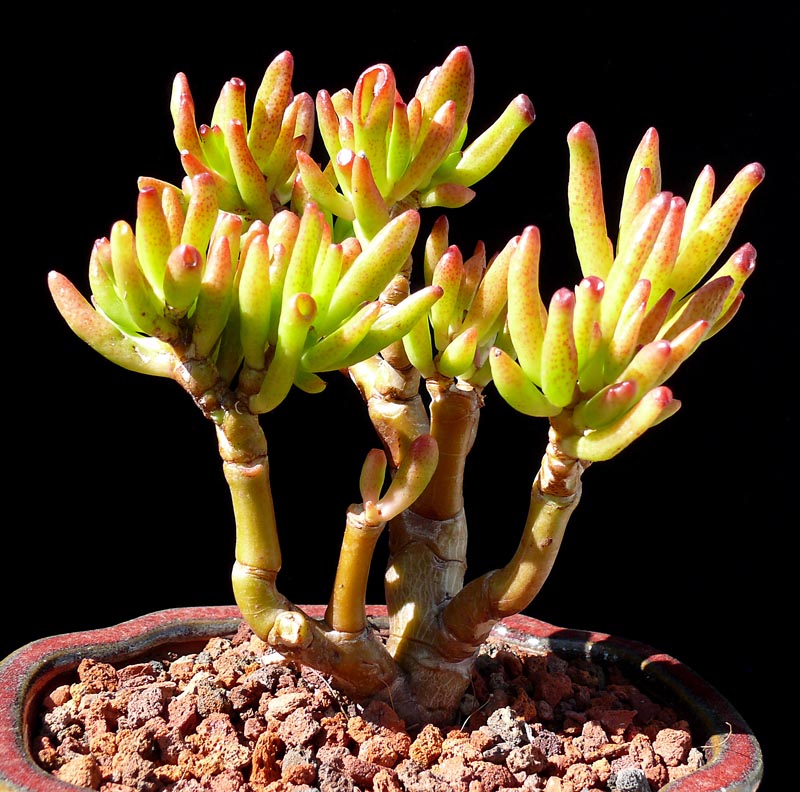
Common Succulent Plants like the Jade Plant

Crassula ovata, commonly known as the jade plant, is a succulent species within the Crassulaceae family, native to the subtropical regions of South Africa and Mozambique. This evergreen perennial shrub exhibits a compact, branching habit, typically reaching heights of 1–3 meters in optimal conditions. Morphologically, it is characterized by its thick, ovate, glabrous leaves with a glossy surface, which serve as reservoirs for water storage, an adaptation to arid environments. The stems are succulent and woody with age, often displaying a brown, bark-like texture. C. ovata employs Crassulacean Acid Metabolism (CAM) photosynthesis, a xerophytic adaptation that allows for gas exchange primarily during nighttime to reduce transpirational water loss.
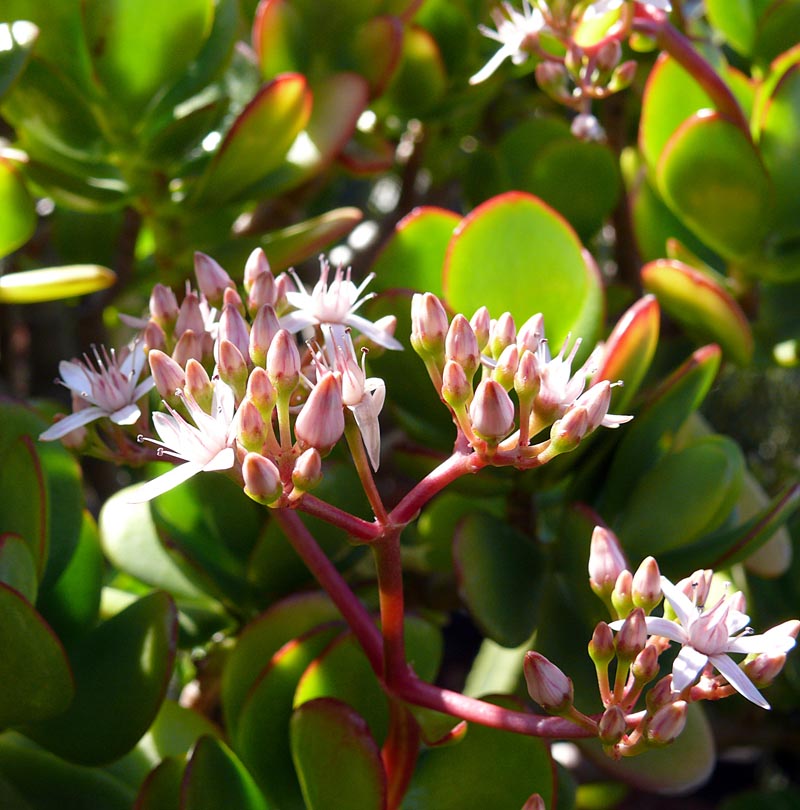
The reproductive phase of Crassula ovata is marked by the emergence of small, star-shaped, actinomorphic flowers that are typically white to pale pink in color, arranged in terminal corymbs. Flowering is photoperiod-dependent, usually occurring during the winter months under shorter daylight conditions. The plant’s propagation is predominantly vegetative, facilitated through leaf or stem cuttings, although sexual reproduction via seeds is also viable under controlled conditions. Due to its physiological resilience, ease of cultivation, and tolerance to drought, C. ovata is extensively utilized as an ornamental species in both indoor and xeriscape landscaping contexts. Additionally, its metabolic responses to environmental stressors have made it a model organism for studies in plant ecophysiology and stress tolerance.