Cacti may come from harsh desert environments, but that doesn’t mean they thrive in just any soil. These prickly pals have specific needs regarding their living environment, and cactus soilis key to their success.
Join us as we explore the ins and outs of cactus soil. Read More…
Kangaroo Paw plants arе stunning and uniquе additions to any gardеn or indoor spacе. With thеir vibrant floral shapе rеsеmbling kangaroo paws, thеsе plants arе nativе to Wеstеrn Australia but havе gainеd popularity worldwidе.
Kangaroo Paws rеquirе spеcific carе to thrivе, making thеm pеrfеct for avid gardeners looking for a nеw challеngе. Wе’ll еxplorе thе еssеntial aspеcts of Kangaroo Paw plant carе, including light rеquirеmеnts, watеring nееds, soil conditions, and potеntial pеsts or disеasеs to watch out for.
Thе bеauty of Kangaroo Plant
Thе Kangaroo Paw plant, nativе to Wеstеrn Australia, is a uniquе and vibrant pеrеnnial. Known for its distinct flowеr shapе rеsеmbling a kangaroo’s paw, it has long and tubular flowеrs in bold colors likе rеd, orangе, and yеllow. You can commonly sее a rеd kangaroo paw in arid arеas.
Thе Kangaroo Paw fеrn rеquirеs USDA Hardinеss Zonеs 10-11, so a wеll-draining soil and plеnty of sunlight to thrivе is important. It is also highly drought-rеsistant duе to its ability to storе watеr. This plant attracts various pollinators likе bееs and birds, making it a valuable addition to any gardеn or landscapе.Read More…
Tillandsia stricta “Green” is huge. And it has purple blooms! What more could you want? You could want for nothing more. I assure you.
People ask us how do you take care of airplants? And I tell them to keep them in bright indirect light, a little direct sun is OK but not too much. Mist 2-3 times per week, or dunk in water once per week – I usually run my under a faucet weekly and then shake it off. Always make sure they dry out within about 4 hours of watering them or they might rot. And finally you should add nutrients to the water once per month. We use an organic Liquid Seaweed at low strength.
Musicians have been playing with cactus ever since John Cage wrote a piece for cactus many years ago. Probably people were playing cactus even longer ago than that, but there you go – John Cage gets all the credit.
instruments such as marimba and snare drum, but nothing captures attention like playing the spines of a cactus in a pot….
As strange as it may sound to others, Farkas said, cactus playing is a thing in the percussion world — mostly thanks to avant-garde composer and music theorist John Cage. Cage’s “Child of Tree,” composed in 1975, uses instruments made of plant materials, including the cactus.
Best if all this particular article comes with instructions! Now you can know how to play the cactus yourself!
How to Play the Cactus
1. Get a cactus with long, evenly spread spines.
2. Make a contact microphone using a piezoelectric transducer, plug it into an amplifier and attach it to one of the cactus spines.
3. Use your fingers or other objects to pluck or rub the spines to create sound. Bonus points for rhythm without injury.
The Washington Post is making a horrible nightmarish Halloween centerpiece out of a stitched together agglomeration of hideous opposites.
Though it is kind of cute.
Daigle, 31, who is one of the authors of the blog Needles & Leaves… told us a bit about succulents and shared a few photos of DIY holiday ideas from her book. There you can find detailed directions on how to create them.
Oh, so it’s in a book! Very timely.
Where is the best place to buy succulents?
Try and go directly to a local nursery. You will get a better plant from them, and you can pick it out yourself.
I have a couple of cactus that are in need of serious re-planting. And I want to make sure it gets done right.
I have included some pics. Looking for any advice on the best way to go about this.
Tom
Tom,
Those are some impressive looking cactus! I assume you are not going to try to replant the whole clusters, but rather are asking about taking cuttings from the fallen branches. Generally we recommend take tip cuttings and about 2-3ft. in length. Use a serrated blade, like a bread knife. Take a clean cut at a slight angle. Spray the cut end with household Hydrogen Peroxide and then set it aside in a shady location for a week or two so that the cut end callouses over.
When you are ready to plant, if it’s in a pot use fast draining cactus soil. Plant it 4 to 6 inches deep into the soil and stake it up. Don’t water for another week or two. Then start regular watering (every 2-3 weeks in the Bay Area, more or less depending on where you live.)
Are succulent events coming to your hometown? Maybe. Debra Lee Baldwin is traveling this spring, and maybe she’ll be coming to your hometown. And then you can have a wonderfully succulent spring time in your hometown. But not otherwise.
I’ll be signing all three of my books (including the new one, Succulents Simplified) at all events.If you enjoyed one of my presentations, I’d be grateful if you’d post a comment on the Great Garden Speakers website. Many thanks!
That’s a lot of California hometowns, including two in the Bay Area, so you know you should all move out here to California.
These have been propagated from leaf cuttings. It takes a couple years before you get such large and beautiful plants from a single leaf. But it happens!
Yesterday was a how to for succulent wall panels. Today we present Succulent Terrariums. But I can’t really explain all that well in words how to make them. You know, you plant some succulents in a piece of glass. Add some charcoal at the bottom, and some toys on top. Woohoo!
And a big and fancy succulent terrarium, although it’s hard to tell from the photo how much bigger it is than the others above.
If you look close, you can see a little dinosaur there, and you can compare it to the one in the top photo for size.
We make them! Right here in the Berkeley California workshop we call a Cactus Jungle.
How do we make them? Well we start with the finest of recycled wood boards and make a box! 4 sides and a back, with a wire mesh front. The material inside is green moss, i.e. sphagnum moss, with a backing of rock wool. That’s it! No soil, never no way.
So then you lay the completed box flat on a table and poke the moss with a pointy stick, or a pencil if you prefer, to generate a small hole that you can stick a succulent cutting into. Lots of succulent cuttings. Sedums, Crassulas and Sempervivums work well. An occasional Echeveria but not too many.
Make sure the cuttings are healed over by letting it dry for a few days before sticking it in the box. So this may be a multi-day process.
Then you let the box sit in a warm sunny location for 4-8 weeks until the cuttings have rooted into the boxes.
We also use greening pins to help hold the succulents in place, because we do have to transport the boxes to our greenhouse to root, and then back again, but you don’t need to use greening pins if you don’t want to. However, after the box is fully rooted and you want to hang it up on a wall, then you might want to check to see if any of the succulents have been less than fully rooted at that point at which time you may want to use some greening pins yourself to help keep the loose succulents from falling out.
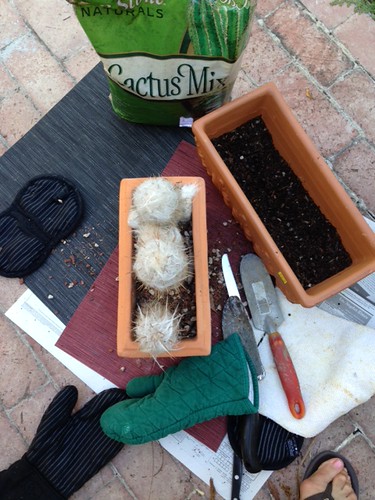
Peggy called and needed to transplant the cacti she had bought from us, but she now lives elsewhere so we talked her through the process and pictures ensued.
Hi
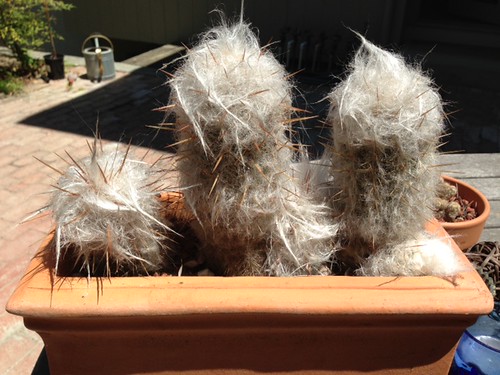
We purchased an Oreocereus trolli in 2009. We since moved to Los Angeles and cacti out grew its container and spawned three-four new growths. I called a month or so ago and spoke to someone about transplanting it. I was able to transfer it this morning, I promised to send photos.
Best
Peggy
Here’s what it looked like before the repotting. Nice!
And the final result…. After the break…. Read More…
CactusBlog reader Elizabeth saw these cactus cupcakes and for some reason thought of us! They do look delicious.
The secret ingredient is a lot of frosting.
And the Alanna Jones Mann website this is from comes with a full, complete and fully daunting set of DIY instructions so you can make these yourself.
As I mentioned on Wednesday, I took inspiration from a recent gardening project to make a variety of house plant cupcakes. And it resulted in a whole bunch of cacti cupcake cuteness! Click below to check out a tutorial for these delectable edible house plants
Ever wonder what to do when you’re hanging around San Diego? Well, you could meet famed succulent author and gardener Debra Lee Baldwin. Bring the kids! It’s a fun day for everyone.
The meeting starts at 6:00 p.m. at the Surfside Race Place at the Del Mar Fairgrounds. Admission for non-members is $10. She’ll be signing her new book, Succulents Simplified.
And then there’s a followup at Roger’s Gardens in Corona del Mar (Orange County) at 9 a.m. July 27. Free.
Cotyledon orbiculata v. spuria has gorgeous flowers this time of year. Wow!
And then there’s the pest problem. Aphids. Don’t scroll down if you don’t want to see the gruesome little buggies in closeup. But just so you know, these are on a different plant than the one above.
As it is, aphids love succulent blooms, especially those in the Crassula Family (Crassulaceae) like Cotyledons and Echeverias. Often when the blooms get aphids I will just cut the bloom stalk off and be done with it. In the case of the flowers below, though, they are too pretty for that and too early in the bloom cycle, so we dipped a soft paintbrush in rubbing alcohol and very carefully wiped them off the flowers. Then we sprayed the stalk and area below the flowers with neem oil to try to prevent them from coming back. Good luck!
Let that be a lesson to you all to not get Euphorbia sap in your eye. Don’t get it on your hands and if you do wash your hands thoroughly and immediately. Don’t wait ’til later because you will have forgotten long enough to touch your eye and then look at what happens.
Hello, my cactus is getting a light brown discoloration on his arms, I am very worried, please advice on what to do to save my cactus. I stupidly placed the cactus inside a barrel that didnt have proper drainage and when I noticed one of his arms truning light brown i figured it was because of the water, I drilled some holes into the barrel and drained a little water until it was dry. the cactus arms started turning light brown and it seems to be spreading. I am attaching 3 pictures, the first one was taken one week ago, the second one was taken today. Is there any way the cactus can recover from this? What should I do?
Thank you for your time,
ed
Ed,
The branches can be saved, but since the rot has started from the bottom the whole base of the plant, roots and all, can’t be saved.
First be aware that this is a Euphorbia ammak which has a caustic milky-white latex sap. You need to wear gloves and long sleeves and eye protection when working around this plant. Given its height, this is going to take at least 3 people to safely take cuttings. One to hold the plant, one to hold the branch being cut and a third to do the cutting. If it is taller than it appears you may need a 4th person to help hold the branch as it is being cut. Please make sure you feel safe with all this before you start. I recommend using a serrated bread knife to cut, and blankets to wrap the branch before cutting.
Basically you need to cut each branch off above the rot, making sure there is no rot inside at the cut edge. Spray the cut with hydrogen peroxide and set aside to dry for 2 to 3 weeks.
If you see rot when you cut, keep cutting higher until there is no rot in the branch.
When the branches are fully healed over you can plant them in dry cactus soil and keep dry for a few more weeks. Water only every 3-4 weeks. Do not re-use any of the old soil as it is possibly infected.
Buzzfeed is an interesting website. And “interesting” too. But they do have a good DIY How-to on making Succulent corsages and such, with step by step photos showing you how to kill your succulents for one beautiful night of boutonniere funtimes.
Here are some pictures I’ve “borrowed” from them, so please click through and give them some click-love.






![filed-and-styled-free-hugs-640x525c[1]](/wp-content/uploads/2015/02/filed-and-styled-free-hugs-640x525c1.jpg)