
Botanical Pencils in the Pencil-Cactus-like Euphorbia Family

Euphorbia tirucalli, commonly known as the pencil cactus or milk bush, is a succulent plant belonging to the family Euphorbiaceae. Native to parts of Africa and India, this plant thrives in arid and semi-arid climates, adapting well to poor, sandy soils. Its distinctive appearance comes from its green, cylindrical, pencil-thick branches that grow upright and densely, with small, inconspicuous leaves that fall off quickly, leaving the green stems as the main photosynthetic organs. Like many Euphorbias, it exudes a milky latex sap when cut, which is toxic and can cause skin irritation or eye damage upon contact.
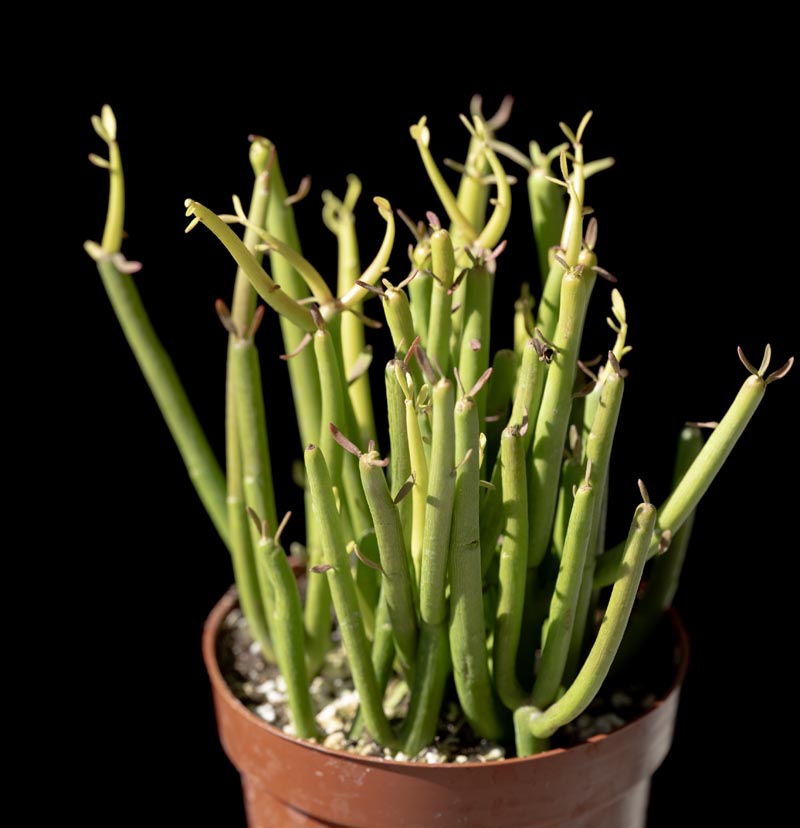
Botanically, Euphorbia tirucalli is a drought-tolerant shrub or small tree that can reach up to 7–10 meters in height under optimal conditions. It produces tiny, yellowish flowers without petals, which are clustered in cyathia—specialized inflorescences typical of the Euphorbia genus. The plant reproduces through both seeds and vegetative propagation, the latter being more common due to the ease of rooting its cut stems. Though visually appealing and often used in xeriscaping and container gardening in warmer climates, caution must be exercised in handling the plant due to its caustic sap. Additionally, in some regions, E. tirucalli is studied for its potential use in biofuel production because of its high hydrocarbon content.


