We recently did a mixed succulent container garden demo for our local Design Within Reach. We filled up one of their fantastic Vaso Rettangolare Illuminated Planters. It will be on display at the Berkeley store for the rest of the month, and maybe longer!
Sollya heterophylla is a low-growing, shall we say creeping, perennial with darling little blue flowers. Except that the flowers are small and hang down below the leaves and so they’re sitting at the nursery in full bloom and nobody knows! But I was able to lay down on the gravel and take a look, and look what I found!
Did you know you could buy Lithops seeds on Amazon? And here I thought Amazon was primarily for cameras and refrigerators.
The reviews aren’t great, but I think that’s just because Lithops are not easy. And it’s true, you probably won’t have any success, and if you do get them to germinate and grow, they’ll rot out anyway. Harsh. But that’s just the way I roll. (And I speak from experience.)
When I first wrote this entry, it sounded too much like an ad, so I changed it and now I seem too jaded.
Let’s start over. Hey kids! Grow your own living stones! Maybe you’ll succeed! Woohoo!
Ceanothus “Tilden Park” is a small-leafed, very shrubby, overly bloomful local variety.
This Wild California Lilac is a late bloomer for the California Lilacs, lasting into early summer. Can handle full sun, and even the inland heat, or the coastal fog belt. Can tolerate poor soils, as long as it has good drainage. Great for large swaths of the hillsides. Attracts native bees.
Easy to prune, but make sure you prune in spring before the blooms.
That would be the Medicine Bow-Routte National Forests and Thunder Basin National Grassland.
Blue Columbine Holmes Miller/Lady Bird Johnson Wildflower Center
Viewers will be treated to a number of wildflowers such as Indian Paintbrush, Kitten Tails and Simpson’s Ball Cactus.
I wonder what Simpson’s Ball Cactus looks like? From the USDA Forest Service’s Coloring pages for kids, we find it looks something like this:
Click to enlarge, and then please print out and give to your local children so they can color the cactus, and then you’ll find out what color the flowers are. Or you can click through here to see a picture of one in bloom in Washington. I don’t know if the Washington and Wyoming populations look the same.
While still avoiding the Arizona newspapers, I came upon this strange fiction in a Colorado newspaper. It seems there are cactus aliens amongst us.
“Ooh, it is warm here,” said Glauke, who had assumed the aspect of the living thing closest to his own physiology — a saguaro cactus, albeit composed mostly of sand to reflect his status as a silicon-based life-form.
Thule, an ethereal being, felt comfortable in the desert. Rather than congeal into a concrete manifestation, he was content to shimmer as a mirage.
Sisyrinchium bellum – Northern California native, easy to grow and get all those pretty little blooms. Look, the thing is, you should be replacing your water-intensive lawn with a native meadow look, and these beauties are a key component between the bunch grasses and the yarrows. I’m telling you the truth here, so you should listen to me.
The unseasonable cold snap has caused all sorts of cactus blooms to have trouble opening. It’s sunny so they’re trying. A little heat would go a long way.
Keith thinks I should have tips for you, and all I can think of is to bring them inside in a sunny window.
Limahuli Valley on Kauai’s North Shore, with its green-mantled spires of volcanic rock, starred as Bali Hai in the movie “South Pacific.” The Limahuli Garden, one of five units of the National Tropical Botanical Garden, occupies 17 acres of this improbably gorgeous place; an additional 985 acres preserve remnant upland forest….
Limahuli’s signature plant is the alula (Brighamia insignis), a lobelia relative that could have been a Dr. Seuss invention; it’s been described as “a cabbage on top of a bowling pin.” The alula’s natural habitat is the precipitous Na Pali cliffs, where only a few individuals remain. No one has ever seen its pollinator in action; some speculate that it may be the elusive green sphinx moth, or something even more rare, if not extinct. Botanical garden botanists have rappelled down the vertical cliffs to hand-pollinate alula plants in situ. Alula has been successfully propagated by Martin Grantham at San Francisco State University, among others – but is hard to keep alive. An attempted introduction at Kilauea Point is looking unsuccessful. It really misses its cliffs, where it’s being displaced by the likes of invasive sanseveria, the familiar houseplant “mother-in-law’s tongue.”
The SF Chron didn’t include any pictures. Here’s a picture of one of our plants:
The Cactus Candy Company sells Pure Prickly Pear Cactus Jelly. Only $1.64!
Or you can make your own, from Epicurious, via a postcard they received. All it takes is:
Ingredients:
2 1/2 cups prickly pear juice
3 Tbsp lemon or lime juice
1 package powdered pectin
3 1/2 cups sugar
Directions:
1 quart of prickly pear cactus fruit should make about 2 1/2 cups of juice. Pluck the fruit from the cactus with a long-handled fork or tongs. Wash under running water, then use a brush to clean (spines left on the fruit will soften during cooking and should come off after fruit is strained.)…
In a saucepan, measure out 2 1/2 cups of cactus juice; add 1 package of powdered pectin. Bring mixture to a fast boil, stirring constantly…. Makes 6 1/2 pints of jelly.
Question: How can I keep my sedum from flopping over? I’ve seen it in other peoples’ gardens and it always seems much sturdier and stockier.
— S.C., via e-mail
Answer: Sedum are succulents, which means they are good at holding water, so they are able to tolerate hot, dry conditions. That’s why the creeping versions especially are standard rock garden denizens. Like most plants that do well in full sun, they might get a little stretchy and loose if grown in too much shade.
A Mexican variety with these amazing white and red-lipped flowers. If you’re not amazed, then go ahead and enlarge the image.
I’ll wait.
Are you amazed yet?
And a great green-leafed shrub that will get burgundy colored in the hot summer sun. Deer-resistant, hardy to 10 °F, and eventually getting upwards of 4ft. tall. Wow!
It’s a Cactus Dip and Chip Tray that would have been perfect yesterday for Cinco de Mayo. Oh well, a day late is better than 2 weeks before New Years. Guacamole is extra. (via)
I had this cute lil plant that was doing just fine until a few days ago i decided to let it have some direct sun for a few days. I’ve had them in the pot for about 2 months on my back porch which gets mostly indirect light all day rather than direct blasts of sun. I haven’t watered it for at least a week and a half, if not longer.
Over the weekend, I brought it out on a little table in the backyard and it seemed fine Sat-Sun. Today was my first day in the backyard since Sunday and poor little plant- what’s happening?? It’s all yellow and limp, looking sad… Is there such a thing as too much sun? Can you help me figure out what’s going on, and if there’s something I can do to help the situation?
Thank you!!
Christina
Christina,
Your plant has a sunburn. Generally, you cannot take plants from shade or from indoor into direct sun – they need to be “hardened off” which means getting them a little sun at first, and gradually bringing them out into more sun over a week or two.
At this point, its hard to tell if they will survive, but get it out of the full sun, into a bright location, and hope for the best. It will definitely lose most of its bottom leaves, but hopefully there will soon be new growth from the tips of the plants.
Peter
Calystegia Macrostegia ssp. Cyclostegia ‘Candy Cane’ can be evergreen with some summer water. Full sun at the coast, with afternoon shade further inland. Fast growing vine, but not one of the more invasive of the morning glories. On a hillside, it can be grown as a groundcover.
Did you know the giant National Hardware Show in Las Vegas has a huge Lawn and Garden section? Well, so that means we’re off to Vegas, baby, this morning to run through the show as quickly as we can, since we have to get back to the store before the gremlins attack.
I really enjoy your blog. Really getting into succulents now. Went to a garage sale a few weeks ago and bought this cactus . Could it be a rat tail?? Or an Aporophyllum??
Would appreciate any help you can give me.
Thanks,
Jan
Jan,
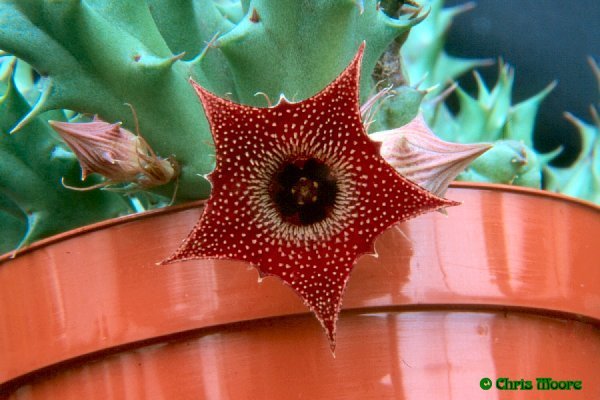
It turns out your plant isn’t a cactus at all, but a stapeliad (in the asclepiad family) and the species is Huernia macrocarpa, also known as the dragon flower. Check out the cute as a button carrion flower here.
We’re posting a cactus calendar of events everywhere in the country for you. I hope one of these works for you.
Fresno, California
Fresno State is hosting a water-wise plant exchange on Saturday, May 8 from 8:00 a.m. to noon at the Fresno State Horticulture Greenhouses, 3150 E. Barstow Ave., just east of Chestnut Avenue in Fresno.
The Cactus Show and Sale takes place this weekend at Sierra Vista Mall, May 15-16.
Next up…
Corvallis, OR
The 23rd annual Spring Garden Festival hosted by the Madison Avenue Task Force included clinics and workshops by the Benton County Master Gardeners, musical performances and numerous vendors selling plants and garden art. Plant enthusiasts could find… wreaths of succulents…
Oops, sounds like we missed that one.
I guess that’s enough calendering for one day. Stay tuned for more, later, maybe.