
It’s a Tillandsia. I don’t know what the species is, and I’m sure no one could possibly know. Maybe I could make one up. Lets go with Tillandsia rubrifolia.

and Ross Valley Nursery
It’s a Tillandsia. I don’t know what the species is, and I’m sure no one could possibly know. Maybe I could make one up. Lets go with Tillandsia rubrifolia.

Aloe longistyla
A very nice medium compact solitary stemless aloe that gets around 10″ across. This guy likes a lot of sun, and can handle extreme drought situations, so you know you like it. It is what we in the horticultural business like to call “useful.” Well, I just made that up.

Epiphyllum species hanging off a tree in Carara National Park, Costa Rica

Aloe cryptopoda
The blooms are coming in orange and turning bright yellow as they open. These are just about to open, so you can see the yellow starting to appear.
That title above? That’s not actually the common name for this particular aloe, but I like the word. Kokerbom, or Quiver Tree, is actually this one.

Phlomis fruticosa
A bold grey shrub for a warm, sunny border with beautiful yellow whorls of fall flowers, and apparently into winter as well.
I had to tone down the brightness of the yellow in photoshop. The flowers in real life are too brilliant for the blog.

Crassula ovata
I generally ignore the lowly Jade Plant. We sell plenty of these puppies, large and small, but who cares? In fact, this is the first picture I’ve even taken of the plant. Anyway, sometimes the flowers are pure white, and sometimes they lean a bit more to the pink. Here’s a pink tinge for you.
And it’s after Christmas!

I don’t understand, don’t these plants have calendars at the ready? They can stop blooming now if they want.
Plants are the Strangest People has a long discourse on the care and feeding and his personal dislike of Adeniums. Lots of good information, notwithstanding the fact that I’m quoted.
Here, have a pretty adenium flower picture:

This has been much blogged, but here’s the green roof on the top of the Academy of Sciences building in Golden Gate Park.

If you look very closely you can see that it’s all California native plants.

Oh, and look over there, I see some Dudleyas! So many succulents. What’s that? It’s a Sedum? It is!
These cell phone pictures aren’t very good. Maybe I should go back to using my camera.

Sansevieria “Skyline” on a frosty christmas morning.

No cactus in this sketch. Maybe behind the house.
Here’s a closeup of yesterday’s aloe in bloom.

Aloe ferox
Did I mention that this is a tree aloe, and is regularly grown for the aloe vera gel? They harvest the large spiky leaves with a hatchet. Chop them right off.
I feel a limerick coming on, so you may want to back away from the computer as quickly as you can.
A girl with a hat on her head
Was sitting in the middle of a cactus bed
She was wrapping a present
The garden was pleasant
So the garden gnome being wrapped she did wed.
I warned you.
Here’s a wedding picture for posterity:


Aloe ferox
The bloom stalk is quite impressive. This one is around 2 ft. tall on a plant that has barely started a trunk. The bottom blooms have just begun to open, and they will work their way up the stalk.
It’s so big.

Phalaenopsis
These Asian epiphytic shade orchids come in many colors, in fact over 60 species, though I don’t know what the species of any of our individual plants are, since we’re cactus specialists, not orchid specialists, you know. Nice run-on sentence, Peter.
Click the image for the more full view.

Echeveria derenbergii in bloom, indeed. Such precious little plants with such brilliant tightly packed flowers that I can’t let pass this little story:
One day we were looking for space for our little store, before we got the current nursery, and we got a space and signed a lease and gave the landlord a small blooming E. derenbergii as a thank you. And then the lease all fell apart and we lost the space and she gave back the plant. I said she could keep it, but she said it was bad luck to keep a gift after everything had fallen apart.
Now you know.

So like, these little baby Aloe marlothii’s are just so spiny and adorable when young, even if they eventually get to like 10 ft. tall and all.

Oxalis herrerae
Gee, I wonder what PBS has to say about this plant? Well lets go take a look:
Oxalis herrerae is a species from Peru. It can grow up to 3 feet (1 meter) and can tolerate a wide range of soil conditions from full sun to part shade. In lush soils with good watering, it will retain it’s leaves and will drop them to reveal a succulent when water is withheld. The most interesting thing about this species is the swollen petioles which gets rather fat in full sun and spindly with less sun. Flowering spike carry numerous 1″ yellow flowers which is most prolific in spring and summer. It can be cut back hard in the spring for a tamed appearance. Propagation is easy by stem cutting. This is a fun one to have for anyone who likes arborescent Oxalis.
Well, yeah, that does seem right.

Oxalis vulcanicola
A South American succulent species that is only semi-evergreen, often dying back in the heat of August or September. But come back it will, little grasshopper.
Have I mentioned that we like the native Dudleyas?

Dudleya caespitosa, can be found as far north as Monterey.
They like a lot of sun, slowly clumping with individual rosettes reaching up to 12″ across. They like rocky outcroppings and are fond of nearby sheep.
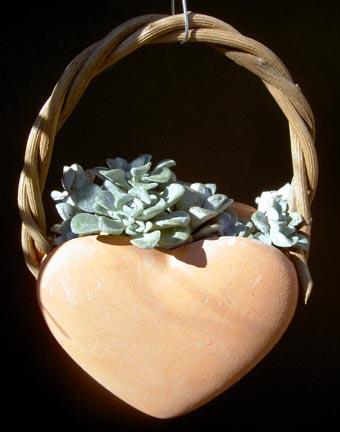
Sedum spathulifolium
I’m back from the sinus troubles, and feeling mostly OK now, and just in time for the family coming to stay over Thanksgiving.
Plus, it appears I’m having a photography exhibition at the store, really our 4th Art Exhibition of the year!
You know my photos from the website and the blog, now see them in person – enlarged and framed.
Or just take a break from Black Friday and come have some fine wines (Hap’s been picking out some nice ones), warm coffee and bread + cheeses too.

Peter Lipson Photography
November 28 – December 24, 2008
Opening Party
Friday, November 28, 2:00 pm to 5:00pm
Cactus Jungle Nursery and Garden
1509 4th Street, Berkeley 94710
510-558-8650
Did I mention that you’re invited?

Penstemon “Pike’s Peak”
I’m still feeling too dizzy to type much about this purple plant. Maybe if I drink some coffee I’ll feel more like perusing the purple plant properly, but until then, I think I’ll go take a nap. Pretty flower.
A very appropriate name for a very pretty bright red flower.

Salvia greggii “Red”
Posting will be slow through this weekend while I am recovering from sinus surgery. I’m a little dizzy, not that today should be different than any other day.
Anyway, have a butterfly plant:

Asclepias curassavica

Drosera adelae
Here we have a fine example of a sundew from Australia. It’s practically nature’s flypaper. Sticky and attractive to flies, it digests the insects right out in the open for all to see.
I especially like the new fronds unfurling.
And those are bloom stalks, but the flowers were too tiny for me to catch on film.

Adenium obesum
The classic succulent flower. The color naturally ranges from white to red, with many pinks in between. Grows a moderate sized caudex, with long succulent stems. Some people like to name a variety when they find a flower color they like, but I am morally opposed to such frippery. The flower colors vary naturally, and widely. They’re individuals, don’t you know. They aren’t all exactly the same and that’s OK.
Did I mention that I like my camera?

We had a different plant labeled A. urbicum. But then we decided we were wrong. And that this one must be A. urbicum. What do you think?
Aeoniums are difficult. There aren’t a lot of good pictures from which to ID them. We’re clearly going to have to get the big Aeonium book from Australia. That’ll be fun. Then we’ll change all the names around again.

Crassula perforata “Tom Thumb”
This miniature version of the ever-popular “Jade Necklace” is a bouquet of flowers all in one. No need for anything else. I mean, look at how those stems hold those little blooms up in the air. You don’t need to cut the stems and prop the cut blooms up in a bud vase. Oh no, you can just leave them there, as they are, potted up and everything. And you can enjoy the little bouquet for weeks. I say you should get one for your mother, if her birthday is this month. You’ll thank me later.

Argyroderma testiculare – a small mesemb with a funny name. I wonder why they call it that? Oh well, I guess we’ll never know.
